 Réseaux & Télécom
(5)
Réseaux & Télécom
(5)
 Système d’information
(12)
Système d’information
(12)
 Poste de travail
(13)
Poste de travail
(13)
 EMAIL
(7)
EMAIL
(7)
 Communication
(4)
Communication
(4)
 Documentation
(1)
Documentation
(1)

 Outils collaboratifs
(12)
Outils collaboratifs
(12)
 Conférence à distance
(5)
Conférence à distance
(5)
 Organisation SI
(25)
Organisation SI
(25)
 Sécurité des systèmes d’information
(4)
Sécurité des systèmes d’information
(4)
 Informatique scientifique
(1)
Informatique scientifique
(1)
 Innov’Space
 Calcul haute performance
(16)
Calcul haute performance
(16)
 Digital Learning
(10)
Digital Learning
(10)
 Logiciels en licence éducation
(5)
Logiciels en licence éducation
(5)
 Locaux numériques
(6)
Locaux numériques
(6)
 Gestion administrative
(9)
Gestion administrative
(9)
 Ressources humaines
(5)
Ressources humaines
(5)
 Scolarité
(2)
Scolarité
(2)

 Séminaires DAEP 2020

Publié le mercredi 11 septembre 2019
Dernière modification le 6 septembre 2021.
salle 38.051
salle 38.137
salle 38.137
Salle 38.137 et Hyflex
lien zoom : https://isae-supaero.zoom.us/j/97621652433
Salle 38.250 et zoom
lien zoom : https://us02web.zoom.us/j/89596539119
Salle 38.250 et zoom
https://zoom.us/j/6177370211?pwd=OERndVZYT0ZuTHZkU0VnZEtTOWpKUT09
Salle 38.250 et zoom
Séminaires DAEP de l’année 2020
Transfert d’énergie et interactions non linéaires entre une canopée de cubes et la couche limite au-dessus
- Mardi 17 novembre 2020 - 11h00 - salle 38.250 et zoom - par Karin Blackman
Les travaux antérieurs dans la couche limite de paroi lisse ont identifié une relation non linéaire entre les structures à grande échelle se produisant dans la couche limite et les structures à petite échelle proches de la paroi (Mathis et al., 2011a). Blackman et Perret (2016) ont utilisé des données expérimentales de couches limites se développant au-dessus de parois rugueuses (constituées d’éléments 3D et 2D) pour étudier les interactions non linéaires. Ils ont constaté un mécanisme descendant similaire à la modulation d’amplitude dans tous les cas de rugosité. Ici on tente d’apporter un éclairage sur le lien entre le mécanisme non linéaire de modulation d’amplitude mis en évidence pour une couche limite au-dessus d’une canopée de cubes, et les transferts d’énergie entre structures de grandes et petites échelles. Pour cela, la méthode de décomposition triple est appliquée à l’équation de bilan d’énergie cinétique turbulente afin d’analyser les termes dominants dans les transferts d’énergie et d’évaluer les interactions entre échelles.
Travaux de recherche sur la compréhension et la modélisation de la transition Bypass
- Jeudi 5 novembre 2020 - 11h00 - salle 38.137 Hyflex - par Olivier Vermeersch (ONERA)
Étude aérodynamique et acoustique de configurations propulsives type doublet contra-rotatif
- Lundi 2 novembre 2020 - 11h00 - salle 38.250 et zoom - par Maxime Fiore (Cerfacs)
Modélisation turbulente en décollement de coin
- Mardi 27 octobre 2020 - 11h00 - salle 38.250 et zoom - par Jean-Francois Monier
Perturbations optimales dans les jets ronds inhomogènes
- Vendredi 5 juin 2020 - 11h00 - visio - par Gabriele Nastro
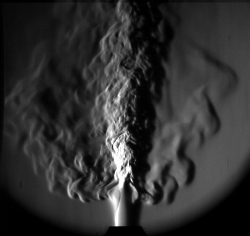
Le jet rond représente un écoulement idéal pour étudier la dynamique transitionnelle de certaines familles d’écoulements, comme par exemple le jet en aval d’un injecteur d’un moteur. Dans ce contexte, la compréhension des mécanismes de transition en aval du jet constitue une étape initiale indispensable à la mise au point de concepts d’injecteur innovant. En particulier, lorsque le rapport entre la masse volumique du jet et celle de son environnement est suffisamment faible, l’écoulement est caractérisé par l’apparition de jets latéraux secondaires à l’origine d’un évasement notable du jet principal (voir figure). À cet égard, Lopez-Zazueta, Fontane & Joly (2016) ont montré pour la couche de mélange à densité variable que le mécanisme proposé par Monkewitz & Pfizenmaier (1991) pour un jet homogène, basé sur le développement de paires de tourbillons longitudinaux contra-rotatifs dans la zone de tresse, est remplacé, en situation inhomogène, par l’apparition de stries de vitesse longitudinale de signes alternés.
Dans ce séminaire, nous proposerons la description de la méthodologie et l’analyse de la dynamique des perturbations optimales. En particulier, cette étude vise à analyser les instabilités secondaires bidimensionnelles et tridimensionnelles du jet rond à densité variable, incompressible et à grand nombre de Froude, afin de vérifier la robustesse de ce mode de transition dans le cas des jets ronds inhomogènes et de statuer ainsi définitivement sur la validité du mécanisme à l’origine des jets latéraux.
Étude de l’opérabilité de soufflante à fort taux de dilution sous distorsion instationnaire
- Vendredi 7 février 2020 - 11h00 - salle 38.137 - par Amaury Awes-Cheynis
Inlet distortion can significantly impact turbofan operability. In the present contribution, the focus is on vortex ingestion, which is a type of distortion that has received less attention in the literature for high-bypass-ratio fans of civil engines than inlet separation or boundary layer ingestion. Due to the unsteady and non-axisymmetric nature of the inflow, full annulus computations are performed, using an unsteady RANS approach with a sliding mesh interface between the rotor and the stator. The goal is to provide a detailed analysis and understanding of the mechanisms responsible for operability loss when a vortex is ingested by the fan. To that end, a simplified model of vortex is derived from previous simulations in crosswind conditions including the presence of the ground plane. The study test case is a turbofan demonstrator representative of modern turbofans. Simulations are run with and without vortex at several operating points until rotating stall is observed. The global results show that the vortex ingestion induces a stall margin loss of up to 8%. Modal analysis indicates a stall pattern with 10 cells rotating at somewhere between 52 and 67% of the shaft speed. A comparison of the two configurations shows that the stall inception mechanism is similar with and without distortion. In particular, examining the incidence at the fan blade, a similar critical angle is observed for the two configurations, which is leveraged to establish a stall criterion valid for vortex ingestion cases.
Simulation des transitoires violents et des écoulements pulsés dans les turbines
- Vendredi 24 janvier 2020 - 11h00 - salle 38.137 - par Florian Hermet (Présentation)
Pulsed flows in turbines have many industrial applications (turbocharger, Humphrey’s cycle, ...) However, the influence of pulsed flow on turbine performance is complex and imperfectly understood. There is no clear consensus in the literature regarding generic trends. Those are difficult to extract since a majority of studies are based on industrial geometries (mainly turbocharging radial turbines), which involve strong interactions between many physical phenomena. In order to isolate and understand the main expression of the physics, the problem needs further simplifications, and a clear assessment of the relevant time scales, and performance indicators of the problem. The seminar proposes a review of the research conducted on that purpose which led to consider the academic case of a severe transient regime inside a thin airfoil cascade, caused by a sudden change of inlet conditions. Simulations with increasing complexity (from 1D Euler to 3D LES) are deployed in order to isolate the driving physics.
An Introduction to Deep Reinforcement Learning for Fluid Mechanics
- Vendredi 10 décembre 2019 - 11h00 - salle 38.051 - par Sandrine Berger
Recent publications have demonstrated the potential of Deep Reinforcement Learning (DRL) techniques to solve control and optimisation problems in fluid mechanics. In this scope, our work aims at developing an innovative control strategy of transonic buffeting, relying on the coupling between unsteady Reynolds Averaged Navier-Stokes (URANS) simulations and DRL. The target application is a diamond airfoil designed for microsatellite-dedicated launchers and for which experimental and numerical investigations of the aerodynamic and aeroelastic behaviour were performed by Jeromine Dumon at ISAE-SUPAERO. Nevertheless, the CPU cost associated to this application is particularly high. A preliminary study is hence conducted on a flying flat plate for which low order models of increasing complexity can be considered to decrease the CPU cost of the simulation. The seminar talk will first introduce the key concepts of Deep Reinforcement Learning before proposing a quick review of its application for fluid mechanics. Finally, the first results of the flying flat plate preliminary study will be presented.