 Réseaux & Télécom
(5)
Réseaux & Télécom
(5)
 Système d’information
(12)
Système d’information
(12)
 Poste de travail
(13)
Poste de travail
(13)
 EMAIL
(7)
EMAIL
(7)
 Communication
(4)
Communication
(4)
 Documentation
(1)
Documentation
(1)

 Outils collaboratifs
(12)
Outils collaboratifs
(12)
 Conférence à distance
(5)
Conférence à distance
(5)
 Organisation SI
(25)
Organisation SI
(25)
 Sécurité des systèmes d’information
(4)
Sécurité des systèmes d’information
(4)
 Informatique scientifique
(1)
Informatique scientifique
(1)
 Innov’Space
 Calcul haute performance
(16)
Calcul haute performance
(16)
 Digital Learning
(10)
Digital Learning
(10)
 Logiciels en licence éducation
(5)
Logiciels en licence éducation
(5)
 Locaux numériques
(6)
Locaux numériques
(6)
 Gestion administrative
(9)
Gestion administrative
(9)
 Ressources humaines
(5)
Ressources humaines
(5)
 Scolarité
(2)
Scolarité
(2)

 Séminaires DAEP 2018

Publié le mercredi 6 décembre 2017
Dernière modification le 6 septembre 2021.
Advances in multiphysics aircraft wing aerodynamics
Salle 38.137
Influence des écoulements de cavité inter-disque sur l’aérodynamique turbine
Salle 38.137
Retour d’expérience sur un séjour de recherche sur les systèmes de dégivrage électromécaniques résonants
Salle 38.137
Étude du mélange gazeux produit par instabilité de Richtmyer-Meshkov en régime initial périodique faiblement diffus
Salle 38.137
Regenerative dynamic soaring trajectory augmentation over flat terrains
Salle 38.137
Performance improvement of small unmanned aerial vehicles through gust energy harvesting
Salle 38.051
Direct numerical simulations of hypersonic transition delay over complex wall impedance
Salle 38.137
Salle 38.137
Avancées et perspectives dans les études aéro-structurelles sur les rotors à Reynolds modéré, en environnement libre et confiné
Salle 38.137
Rotary wing decelerators – research itinerary
Salle 38.137
Progress and challenges in simulating combustion with realistic chemistry
Salle 38.137
Combustion instability sensing and control in gas turbines
Salle 38.137
Salle 38.137
Salle 38.137
Salle 38.137
Séminaires DAEP de l’année 2018
Étude numérique et expérimentale pour le contrôle passif du flottement aéroélastique d’une aile
- Vendredi 7 décembre 2018 - 11h00 - salle 38.137 - par Claudia Fernandez-Escudero et Miguel Gagnon (Présentation)
Fonctionnement des rotors carénés faiblement chargés : état des lieux et similitudes
- Vendredi 30 novembre 2018 - 11h00 - salle 38.137 - par Massyl Lagha
Retour d’expérience et perspectives du projet européen H2020 ULTIMATE (Ultra Low emission Technology Innovations for Mid-century Aircraft Turbine Engines)
- Vendredi 9 novembre 2018 - 11h00 - salle 38.137 - par Nicolás García Rosa
Stability and transition of boundary layers and other activities in flow control
- Vendredi 6 juillet 2018 - 11h00 - salle 38.137 - par Erwin Gowree
Combustion instability sensing and control in gas turbines
- Vendredi 22 juin 2018 - 11h00 - salle 38.137 - par Pr. Satyanarayanan Chakravarthy (ITT Madras)
Land based gas turbines used for power generation have to meet stringent low NOx emission standards, for which lean premixed prevaporised combustors are adopted. However, such premixed flames are prone to severe thermo-acoustic instabilities due to feedback of the acoustics generated by the flame fluctuations on the flame’s response. In recent times, data driven and image processing approaches are being adopted for sensing precursors to instabilities so that corrective action can be taken to control them. In the data driven approach, a symbolic time series analysis of the pressure and flame chemiluminescence fluctuations are combined in a mutual-information theoretic framework to develop a robust precursor detection algorithm. A flame sensor has been developed for this purpose by a combination of a fibre-optic probe and quartz windows to be mounted on the combustor wall. Efforts are also focused on combining this with a fibre-Bragg grating for acoustic pressure sensing along with the flame chemiluminescence fluctuations for the mutual information algorithm. High speed imaging of the flame in its approach to instability has been analysed for a quantity termed as the coherent image phase (CIP) based on the Hilbert transform of the images. The CIP provides an excellent basis to evaluate the Rayleigh criterion in comparison with the original image. Next, the scale invariant feature transform (SIFT) algorithm used in computer vision is adopted on the flame images to deduce locations of rotational symmetry in the combustion zone that represent regions of vortex structures involved in causing spatio-temporal fluctuations in heat release rate, leading to instability. Finally, an artificial neural network is adopted to learn from the flame images obtained under thermo-acoustically stable and unstable conditions on the formation of coherent structures followed by the flame so as to detect precursors to instability. A cooled camera probe is being developed to be mounted on the combustor for obtaining real time images to which the above image processing techniques can be employed for precursor detection and corrective action to bring the combustor back to stable conditions.
Progress and challenges in simulating combustion with realistic chemistry
- Vendredi 15 juin 2018 - 11h00 - salle 38.137 - par Perrine Pepiot (Cornell University)
The vital role of simulations and computational insights in reducing pollutant emissions, designing better engines and better fuels, and assessing the technical and economic viability of radically different combustion technologies, is now clearly established. A key enabling step is the development of computational approaches that allow our increasingly detailed knowledge of the chemical kinetics of realistic fuel oxidation to be applied to the modeling and simulation of combustion reactors. In this talk, I will briefly review the challenges associated with the integration of detailed chemical kinetics in reactive flow simulations. I will then discuss the progress we have made in the analysis and reduction of complex kinetic networks, with a focus on graph-based techniques and the characteristics of the stand-alone reduced models they typically generate. Using Large-Eddy Simulations of turbulent flames as case study, I will show how these techniques are enhanced through careful integration and coupling with CFD tools, wherein the flow characteristics adaptively inform the reduced chemical model to be used. I will conclude on the remaining challenges still to overcome, and potential avenues to do so.
Rotary wing decelerators – research itinerary
- Jeudi 7 juin 2018 - 11h00 - salle 38.137 - par Joaquín Piechocki (Université Nationale de La Plata)
The presentation will be about the activities of UIDET GTA-GIAI from Universidad Nationale de La Plata, with special focus on the research progression on rotary wing decelerators made during the last years.
Avancées et perspectives dans les études aéro-structurelles sur les rotors à Reynolds modéré, en environnement libre et confiné
- Vendredi 18 mai 2018 - 11h00 - salle 38.137 - par Sébastien Prothin
Étude du mélange gazeux produit par instabilité de Richtmyer-Meshkov en régime initial périodique faiblement diffus
- Vendredi 27 avril 2018 - 11h00 - salle 38.137 - par Pierre Graumer
L’instabilité de Richtmyer-Meshkov (IRM), théorisée par Richtmyer et mise en œuvre expérimentalement pour la première fois par Meshkov, se produit lorsqu’une interface perturbée entre deux fluides de densités différentes est soumise à une accélération impulsionnelle conduisant au mélange des deux espèces en présence. Cette instabilité joue un rôle important dans de multiples phénomènes physiques tels que la combustion supersonique, l’effondrement des supernovas ou encore dans le mécanisme de fusion par confinement inertiel (FCI). La FCI consiste à produire des réactions de fusion nucléaire à partir d’un mélange de deux isotopes de l’hydrogène : le deutérium et le tritium. À cette fin, les isotopes sont conditionnés sous la forme d’une capsule sphérique cryogénisée de quelques millimètres de diamètre et comprimés au moyen d’un rayonnement laser de très forte puissance. Ce protocole permet alors d’obtenir les conditions de pression et de température ( 2.107K) nécessaires à la production d’un plasma. Celui-ci se détend vers l’extérieur de la cible et génère en réaction une onde de choc dans la direction opposée qui doit finalement permettre d’atteindre au centre de la cible les conditions de température ( 1.108K) et de densité ( 100g/cm3) indispensables à la fusion des isotopes. La réalisation d’un tel processus nécessite que l’éclairement de la cible soit parfaitement homogène et que celle- ci soit parfaitement sphérique. En pratique, l’éclairement non-uniforme et les défauts géométriques de la cible provoquent le développement d’instabilités hydrodynamiques (Instabilités de Rayleigh-Taylor et de Richtmyer-Meshkov) aux interfaces de densités. Le mélange ainsi produit diminue le rendement énergétique de la réaction, et peut empêcher d’atteindre les conditions thermodynamiques nécessaires à la réaction de fusion. L’objectif de ce travail de thèse s’inscrit dans la continuité d’une précédente thèse menée à l’ISAE/DAEP (Bouzgarrou) portant sur l’analyse expérimentale du mélange gazeux issu de l’instabilité de Richtmyer-Meshkov. Les expériences réalisées lors de cette précédente étude ont été effectuées au sein d’un tube à choc vertical, et l’analyse du mélange a été conduite à l’aide de capteurs de pressions pariétaux et de mesures optiques résolues en temps (strioscopie, vélocimétrie par effet Doppler (LDV), vélocimétrie par images de particules (PIV)). Afin de créer une interface de densité entre les deux gaz à l’intérieur du tube à choc (Interface Air/SF6 dans le cas considéré ici), une fine membrane nitrocellulosique d’épaisseur 0.5μm a été montée en sandwich entre deux grilles métalliques à mailles carrées assurant à la fois le soutien mécanique de la membrane et la création d’un motif de perturbation tridimensionnel périodique au niveau de l’interface de densité. Ces travaux ont mis en évidence la nécessité de s’affranchir de la membrane afin de pouvoir convenablement mettre en œuvre les techniques de mesures laser telles que la LDV et la PIV. En effet, lorsque l’onde de choc incidente vient impacter la membrane, celle-ci se rompt et produit un grand nombre de micro-débris qui engendrent des réflexions lumineuses parasites de la nappe laser empêchant la mesure. L’objectif de nos travaux est donc de changer de protocole expérimental en concevant et en réalisant un nouveau système de génération de l’interface de densité n’utilisant pas de membrane, afin de pouvoir réaliser une étude précise du mélange turbulent issu de l’instabilité grâce aux mesures optiques résolues en temps.
Direct numerical simulations of hypersonic transition delay over complex wall impedance
- Jeudi 29 mars 2018 - 14h00 - salle 38.137 - par Carlo Scalo (Purdue University)
The talk will discuss recent results from direct numerical simulations of hypersonic transition delay over porous coatings (Sousa et al., JSR, 2018). Transitional modes in high-speed boundary layers over canonical geometries, such as slender cones, exhibit acoustic wave propagation properties, where the boundary layer (due to its thermally stratified structure) acts as an acoustic waveguide sustaining resonance and growth of the instability waves. The latter are acoustically interacting with the underlying porous cavities, responsible for acoustic absorption and hence mode amplitude attenuation. The dynamics of waves propagating in porous cavities will be analyzed via direct and inverse eigenvalue approaches allowing to derive a broadband complex value of the surface impedance, which is then applied as a boundary condition to the overlying flow via a time-domain technique. Flow conditions and properties of the porous coatings match the ones from experiments carried out by Alex Wagner at the German Space Center (DLR) in Göttinghen, who has successfully demonstrated the capabilities of porous walls composed of carbon-fiber reinforced carbon ceramics to delay transition by attenuating acoustic modes in the boundary layer.
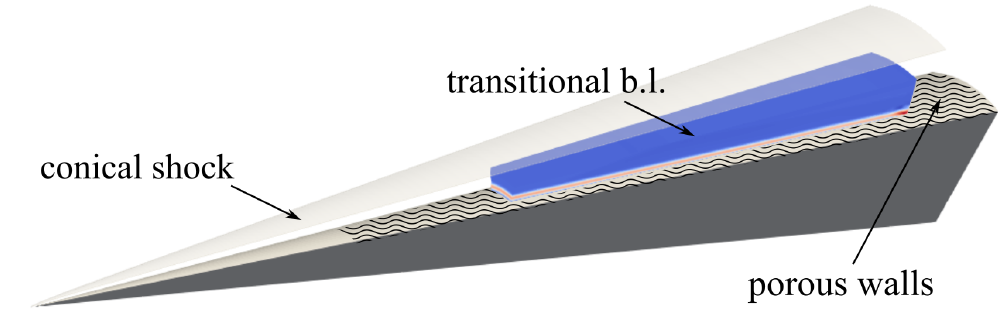
- Computational setup of a transitional boundary layer on a slender cone over porous walls.
Advances in multiphysics aircraft wing aerodynamics
- Vendredi 23 mars 2018 - 11h00 - salle 38.137 - par Éric Laureandeau (École Polytechnique de Montréal)
Retour d’expérience sur un séjour de recherche sur les systèmes de dégivrage électromécaniques résonants
- Vendredi 16 mars 2018 - 11h00 - salle 38.137 - par Valérie Budinger
Ce séminaire vise à restituer un séjour de recherche mené en Allemagne dans le cadre d’une campagne d’essais sur les systèmes de dégivrage électromécaniques résonants. Il abordera d’abord les aspects scientifiques : les enjeux et challenges des systèmes de dégivrage électromécaniques résonants. Puis la présentation se focalisera sur les aspects humains d’une telle expérience : comment mettre en place un séjour de recherche à l’étranger ? Quels sont les difficultés à surmonter et bénéfices d’un tel séjour ?
Influence des écoulements de cavité inter-disque sur l’aérodynamique turbine
- Vendredi 16 février 2018 - 11h00 - salle 38.137 - par Maxime Fiore
Dans une turbine de turbomachine, les jeux nécessaires entre les pièces fixes reliées aux stators et les pièces tournantes reliées aux rotors conduisent à des espaces sous le moyeu appelés cavités. L’air chaud de veine principale peut entrer dans les cavités et endommager les disques tenant les aubes de rotor situés dans les cavités. Afin d’éviter ce phénomène, de l’air du compresseur est prélevé et introduit dans ces cavités afin de diminuer la température de l’écoulement hors-veine tout en empêchant l’air chaud de la veine d’y entrer. Cependant une partie de cet air de cavité a tendance à s’échapper dans la veine principale conduisant à des pertes additionnelles pour la turbine. Au travers de différentes approches numériques (RANS, LES, LES-LBM), l’écoulement dans la cavité et les phénomènes d’interaction d’écoulement veine / hors-veine sont analysés.
Regenerative dynamic soaring trajectory augmentation over flat terrains
- Vendredi 9 février 2018 - 11h00 - salle 38.137 - par Nathan Long
A gliding technique, known as dynamic soaring (DS), replicates the flight pattern of the wandering albatross bird to enable energy neutral, repeatable flight trajectories. This study investigated the potential for DS to act as a basis for UAV battery power regeneration by means of a windmilling propeller placed on the nose of the aircraft. In order to give an indication of the type of atmospheric and environmental conditions necessary to perform regenerative dynamic soaring (RDS), RDS trajectories were optimised for the DT-18 drone. The optimal flight paths for varying amounts of energy regeneration, surface conditions and periodic constraints were obtained and compared to a base, energy neutral DS case. The findings suggest that by slightly altering the DS flight pattern, significant battery recharge levels can be reached for small drones under certain conditions.
Performance improvement of small unmanned aerial vehicles through gust energy harvesting
- Vendredi 26 janvier 2018 - 11h00 - salle 38.051 - par Nikola Gavrilovic
Recent works driven by the unfailing experience from nature have shown a significant amount of energy available in the atmosphere. This energy is coming through in the form of vertical air motions described as spatial gradients, such as thermals, shear layers, orographic lift and short-period temporal gradients as (for example) gusts. There are strong indications that birds use their feathers for sensing flow perturbations. Being fluffy and subjected to fluttering provoked by small disturbances, birds have natural sensory system, which enables them to feel and exploit flow disorders. However, for a variety of reasons, it is understood that identical copies from nature to manmade technologies are not feasible. Instead, a creative inspiration and conversion into technology are often based on various steps of abstraction.
The performance of mini UAVs being constrained by onboard energy due to their limited size can be significantly enhanced by specific flight strategies according to expected atmospheric formations or even continuous disturbances. Most of the energy harvesting methods rely on an active control system that detects and exploits the energy of atmospheric turbulence through intentional maneuvering of the aircraft.
The presented results are a work of a PhD student of third year. The first part includes theoretical modelling of atmospheric turbulence for both 2D profiles and 3D flying environment and flight simulations with appropriate aerodynamic models with active control for gust energy extraction. The second part is related on bio-inspired wind field estimation with measurements through wing surface pressure distribution. Flight test measurements have been performed in association with ENAC. The third part shows results from international collaboration with RMIT University from Melbourne Australia. It consists from wind tunnel campaign and flight tests for gust energy extraction. Finally some future work will also be presented considering the time left till the end of the thesis.