 Réseaux & Télécom
(5)
Réseaux & Télécom
(5)
 Système d’information
(12)
Système d’information
(12)
 Poste de travail
(13)
Poste de travail
(13)
 EMAIL
(7)
EMAIL
(7)
 Communication
(4)
Communication
(4)
 Documentation
(1)
Documentation
(1)

 Outils collaboratifs
(12)
Outils collaboratifs
(12)
 Conférence à distance
(5)
Conférence à distance
(5)
 Organisation SI
(25)
Organisation SI
(25)
 Sécurité des systèmes d’information
(4)
Sécurité des systèmes d’information
(4)
 Informatique scientifique
(1)
Informatique scientifique
(1)
 Innov’Space
 Calcul haute performance
(16)
Calcul haute performance
(16)
 Digital Learning
(10)
Digital Learning
(10)
 Logiciels en licence éducation
(5)
Logiciels en licence éducation
(5)
 Locaux numériques
(6)
Locaux numériques
(6)
 Gestion administrative
(9)
Gestion administrative
(9)
 Ressources humaines
(5)
Ressources humaines
(5)
 Scolarité
(2)
Scolarité
(2)

 Séminaires DAEP 2019

Publié le mardi 29 janvier 2019
Dernière modification le 6 septembre 2021.
Salle 38.137
Salle 38.137
Salle 38.137
salle 38.137
salle 38.137
salle 38.137
salle 38.137
salle 38.137
Séminaires DAEP de l’année 2019
Étude d’une composante singulière du bruit de jet : le screech
- Lundi 25 novembre 2019 - 11h00 - salle 38.137 - par Bertrand Mercier (TU DELFT)
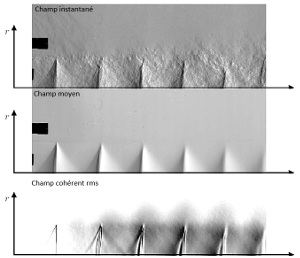
Le bruit de jet est un sujet d’étude majeur en aéroacoustique qui trouve ses principales applications dans les domaines de l’aéronautique et du spatiale. C’est en effet le bruit de jet qui domine la nuisance perçue par les riverains durant la phase de décollage des avions, et qui reste une source de bruit significative au cours de la montée. Ce bruit est attribué au rayonnement des structures turbulentes présentes dans la couche de cisaillement du jet. Du fait de la nature de ces sources, le spectre acoustique du bruit de jet est large bande.
Au-delà de ce constat, lorsque le jet est supersonique et qu’il n’est pas idéalement détendu, une composante tonale de très forte intensité vient, dans certaines conditions, dominer la signature initialement large bande du bruit de jet. Ce phénomène qui soulève encore des questions est appelé le « screech », nom qui fait référence au bruit particulièrement strident qui lui est associé.
Dans ce séminaire, nous proposerons une analyse des mécanismes en jeu dans la génération du screech. Cette étude est principalement basée sur plusieurs campagnes d’essais, qui ont impliqué des mesures acoustiques et aérodynamiques dans la soufflerie anéchoïque du LMFA.
Études des ailes battantes déformables pour le vol en sustentation
- Vendredi 22 novembre 2019 - 11h00 - salle 38.137 - par Daniel Diaz-Arriba
L’étude est fait à l’ISAE-Supaero en collaboration avec l’Institut Pprime à Poitiers. Des essais expérimentaux de type mesures optiques (PIV) sur des ailes battantes flexibles ont été fait dans les installations mises en place depuis plusieurs années déjà au sein de l’Institut Pprime sur la thématique des ailes battantes. De plus, des méthodes non-intrusive de détermination de forces ont été analysées. Par la suite, des simulations (STAR-CCM+) sont conduites afin d’analyser la physique de l’écoulement généré par des ailes battantes rigides et flexibles puis d’entamer un processus d’optimisation des performances aérodynamiques. Finalement, les conditions plus performantes seront testés expérimentalement pour vérifier les résultats.
Nouveaux enjeux d’un système propulsif en rupture : vers une évolution des méthodes de conception et d’analyse
- Vendredi 18 octobre 2019 - 11h00 - salle 38.137 - par Emmanuel Benichou
Dans un souci de diminution drastique de la consommation de carburant, la conception d’aéronefs en général et la cellule propulsive en particulier imposent de revoir dans leur globalité les méthodes de conception du fait d’une intégration toujours plus poussée. Ainsi, les motoristes ont besoin de disposer au plus tôt dans le processus de conception de méthodologies d’aide à la décision, au plus près de la réalité physique imposée par une interdépendance d’une majorité des systèmes avions, dont la cellule propulsive est le plus souvent le point focal.
Retour sur le stage de M2 de deux étudiants en parcours recherche
- Jeudi 10 octobre 2019 - 14h00 - salle 38.137 - par Julien Sablon et Charles Thoulon
Julien Sablon et Charles Thoulon en parcours au recherche au DAEP nous présentent le travail réalisé pendant leur stage de M2. Julien a travaillé sur les écoulements stratifiés autour d’un cylindre à l’École polytechnique fédérale de Lausanne avec François Gallaire, tandis que Charles a travaillé sur les écoulements de tuyère en gaz réel à l’Imperial College avec Émile Touber.
Modélisation du fonctionnement des compresseurs pendant un cycle de pompage
- Vendredi 21 juin 2019 - 11h00 - salle 38.137 - par Ludovic Rojda
Une turbine à gaz est une machine qui permet de fournir de l’énergie au flux de gaz qui la traverse. Les écoulements au sein des différents composants d’une turbine à gaz sont complexes puisque intrinsèquement turbulents et instationnaires. Dans les compresseurs, une des particularités est que la direction de l’écoulement s’oppose à celle du gradient de pression, de sorte que les forces de pression s’opposent aux forces d’inertie. Vers les forts taux de compression, la stabilité aérodynamique de l’écoulement est alors précaire et il suffit d’une légère perturbation aérodynamique pour initier une instabilité du régime de fonctionnement comme le pompage, qui est critique pour l’opérabilité.
Ce phénomène étant systémique, les travaux de thèse ont pour but de modéliser un compresseur haute pression au sein de son environnement banc d’essai durant l’apparition de l’instabilité. Ce type de modélisation vise à permettre une prise en compte pertinente de l’influence des éléments en amont et en aval du compresseur afin de répondre à cette question :
« Quel est l’impact des composants Moteur sur le fonctionnement du compresseur proche pompage et quelle est la stratégie de calcul la plus efficace pour simuler le phénomène de pompage et prédire son impact sur le comportement vibratoire des aubes d’une turbine à gaz ? »
Le phénomène de pompage étant majoritairement longitudinal, l’approche proposée utilise une résolution numérique tridimensionnelle de l’écoulement dans le compresseur et une résolution monodimensionnelle de l’écoulement dans le reste du système. La méthodologie est alors orientée vers un couplage instationnaire d’un code de calcul CFD RANS 3D (elsA) et d’un code de calcul de performance des turbines à gaz 0D/1D (PROOSIS – Fluidapro) dans l’objectif de simuler un cycle de pompage d’un compresseur en environnement installé. Cette approche permet une réduction significative du coût de calcul en comparaison à une simulation tridimensionnelle instationnaire de l’ensemble du système.
Enfin, les oscillations à faible fréquence et grande amplitude qui affectent le système génèrent des vibrations mécaniques capables de détruire le compresseur puis la turbine à gaz dans son ensemble. On comprend alors aisément tout l’intérêt de prévoir au mieux l’apparition et le développement du pompage.
Étude expérimentale et numérique du tremblement transsonique sur un profil diedrique - application au cas d’un lanceur supersonique
- Vendredi 24 mai 2019 - 11h00 - salle 38.137 - par Jéromine Dumon
Modélisation de l’interaction hélice-voilure pour drone convertible
- Vendredi 29 mars 2019 - 11h00 - salle 38.137 - par Yuchen Leng (Présentation)
Dans le contexte de la conception de drone convertible, les efforts aérodynamiques induites par le sillage de l’hélice affecte fortement la mécanique du vol à basse vitesse. Le séminaire présentera les travaux réalisés au sein du DAEP : la modélisation de l’hélice et son sillage, et le couplage du modèle des lignes portantes basé sur bibliothèque MachUp.
Analyse aéro-propulsive par méthode exergétique
- Vendredi 15 février 2019 - 11h00 - salle 38.137 - par Miguel Aguirre
La méthode exergétique est une puissante technique d’évaluation aérodynamique basée sur l’application du 2ème principe de la thermodynamique. Utilisée dans le domaine de la propulsion dès les années 70, son usage a été récemment étendue vers l’aérodynamique externe afin d’analyser des configurations avion innovantes. Le but de ce séminaire est de présenter cette méthode ainsi que ses applications récentes. De plus, les travaux sur le domaine réalisés au sein du DAEP pendant 2018 seront aussi présentés, à savoir : développement du code Epsilon (post-traitement des simulations CFD par la méthode exergétique) et différents travaux de recherche sur des profils et voilures.