 Réseaux & Télécom
(5)
Réseaux & Télécom
(5)
 Système d’information
(12)
Système d’information
(12)
 Poste de travail
(13)
Poste de travail
(13)
 EMAIL
(7)
EMAIL
(7)
 Communication
(4)
Communication
(4)
 Documentation
(1)
Documentation
(1)

 Outils collaboratifs
(12)
Outils collaboratifs
(12)
 Conférence à distance
(5)
Conférence à distance
(5)
 Organisation SI
(25)
Organisation SI
(25)
 Sécurité des systèmes d’information
(4)
Sécurité des systèmes d’information
(4)
 Informatique scientifique
(1)
Informatique scientifique
(1)
 Innov’Space
 Calcul haute performance
(16)
Calcul haute performance
(16)
 Digital Learning
(10)
Digital Learning
(10)
 Logiciels en licence éducation
(5)
Logiciels en licence éducation
(5)
 Locaux numériques
(6)
Locaux numériques
(6)
 Gestion administrative
(9)
Gestion administrative
(9)
 Ressources humaines
(5)
Ressources humaines
(5)
 Scolarité
(2)
Scolarité
(2)

 Séminaires DAEP 2016

Publié le mercredi 6 décembre 2017
Dernière modification le 6 septembre 2021.
De l’atténuation d’une onde de choc au bruit généré par une vanne de pressurisation
Salle 38.137
Étude et contrôle du décrochage d’une aile rigide multi-éléments
salle 38.137
Modélisation de turbomachines par termes sources pour la simulation des interactions avion-moteur
Salle 38.137
Que saurais-je (en aérodynamique) que vous ne sachiez point ?
Salle 38.137
Parallélisation en temps et son application à la CFD : principe et exemples d’application
Salle 38.137
Maîtrise des performances d’une turbine radiale centripète à géométrie variable
Salle 38.137
Predicting Turbofan Fan-Stage Noise Using Low-Order Methods
Salle 38.051
Analytical modeling for acoustic tonal and broadband noise
Salle 38.137
Influence de la distorsion sur le bruit tonal d’un turboréacteur
Salle 38.137
Analyse, caractéristique et contrôle de décollements de couche limite turbulente
Salle 38.137
Modes statiques de brisure de symétrie et aérodynamique instationnaire de corps tridimensionnels épais
Salle 38.137
Resonant mode control in high-speed boundary layers via wall-impedance
Salle 38.137
High-order schemes for high-fidelity DNS and LES of compressible flows over complex geometries
Salle 38.137
Séminaires DAEP de l’année 2016
De l’atténuation d’une onde de choc au bruit généré par une vanne de pressurisation
- Mercredi 26 octobre 2016 - 11h00 - salle 38.137 - par Alice Chauvin
Influence de la distorsion sur le bruit tonal d’un turboréacteur
- Vendredi 21 octobre 2016 - 11h00 - salle 38.137 - par Majd Daroukh (Présentation)
L’évolution des turboréacteurs vers des architectures à très grand taux de dilution (UHBR) se traduit par un raccourcissement de la nacelle et de la distance soufflante - redresseurs. Une forte hétérogénéité azimutale de l’écoulement, appelée distorsion, est alors créée au niveau de la soufflante. L’influence de cette distorsion sur le bruit tonal est étudiée grâce à des simulations numériques instationnaires basées sur les équations de Navier-Stokes moyennées (URANS). Ces simulations sont couplées à des méthodes de prévision acoustique directes, basées sur la formulation de Cantrell & Hart, et hybrides, basées sur le formalisme de Goldstein.
Analyse, caractéristique et contrôle de décollements de couche limite turbulente
- Vendredi 30 septembre 2016 - 11h00 - salle 38.137 - par Antoine Debien
La prise en compte des contraintes environnementales est aujourd’hui un enjeu majeur pour le développement du secteur aéronautique, celui-ci s’orientant vers un transport « plus économique, plus sûr, plus propre, moins bruyant ». Dans ce contexte, l’utilisation de concepts innovants tels que le contrôle d’écoulement, semble être l’une des solutions nécessaires qui permettra d’assurer cette rupture technologique. Cette communication s’intéresse ainsi au décollement, phénomène indésirable intervenant dans nombre d’applications fluidiques, et à son contrôle au travers de deux exemples. Le premier exemple, issu du projet européen PLASMAERO qui avait pour but de démontrer l’efficacité des actionneurs plasmas pour le contrôle d’écoulements de voilures d’aéronefs, correspond à la conception d’actionneurs plasmas à DBD et à leur utilisation sur un décollement mi-corde (Rec = 1,33×10⁶). Le second exemple, réalisé dans le cadre de l’ANR blanc SePaCode qui avait pour objectif la réalisation de lois de contrôle robuste en s’appuyant sur la physique du décollement, traite du contrôle d’un décollement de couche limite turbulente (Reθ = 3500) sur une configuration de rampe à arête vive effectué à l’aide de générateurs de tourbillons pulsés. Nous nous intéresserons ainsi à la compréhension de la physique du contrôle en comparant les résultats obtenus en contrôle boucle ouverte - s’appuyant sur les fréquences caractéristiques de l’écoulement en boucle - à l’utilisation de lois de contrôle en boucle fermée - synthétisées par un algorithme génétique.
Resonant mode control in high-speed boundary layers via wall-impedance
- Vendredi 19 août 2016 - 10h00 - salle 38.137 - par Carlo Scalo

The talk will discuss fundamental computational and physical aspects associated with transitional and turbulent boundary layer control via acoustic resonance and absorption in porous walls. The dynamics of waves propagating in porous cavities will be analyzed via direct and inverse eigenvalue approaches with focus on the characterization of the surface impedance. The latter is defined as the ratio between the Fourier transforms of pressure and transpiration velocities at the interface. High-fidelity numerical simulations retaining full aeroacoustic coupling between the overlying flow and porous walls relying on the time-domain technique by Scalo, Bodart and Lele, Phys. Fluids (2015) will be discussed. Finally, plans to perform direct numerical simulations of the experiments by Wagner et al., AIAA 2012-5865 in hypersonic flow control over ultrasonically absorptive porous coatings will be presented in the context of the recently awarded Air Force Grant FA9550-16-1-0209.
High-order schemes for high-fidelity DNS and LES of compressible flows over complex geometries
- Vendredi 19 août 2016 - 11h00 - salle 38.137 - par Guido Lodato
Modes statiques de brisure de symétrie et aérodynamique instationnaire de corps tridimensionnels épais
- Mercredi 20 juillet 2016 - 14h00 - salle 38.137 - par Olivier Cadot
Pour des géométries simples de corps 3D non profilés, les modes stationnaires de brisures de symétries apparaissent en première bifurcation dans les régimes laminaires des sillages. Ces modes persistent à grands nombres de Reynolds et sont présents à l’échelle industrielle comme en aérodynamique de transports terrestres. Ils produisent une dynamique stochastique globale dominant les efforts aérodynamiques instationnaires. Quelques techniques de stabilisation de ces modes seront présentées.
Analytical modeling for acoustic tonal and broadband noise
- Vendredi 24 juin 2016 - 11h00 - salle 38.137 - par Michaël Bauerheim
To complement experiment, high-fidelity simulation has already attracted broad interest for acoustic noise predictions. In contrast, analytical models are usually thought valid only for simple cases, and applied for validation purposes only. This presentation describes two recent theoretical analysis, bringing up to date the interest of such analytical tools in an industrial context. First, a non-linear analytical framework for self-sustained vortex-driven tonal noise is proposed. It is based on numerical simulations coupled with an analytical non-linear dispersion relation. It is applied to a T-junction with a grazing flow, as a prototype of classical situations encountered in industrial configurations. Second, the scattering of acoustic or vorticity waves by a blade cascade is investigated, typical of stator-rotor configurations as well as swirlers in combustion chambers. The problem is treated by a non-compact mode-matching technique coupled with the analytical Ovenden’s solution of a slowly-varying duct. It allows the analytical description of the blade cascade taking into account curvature and staggered angle effects. Extension of this framework to 3D cases and trailing edge noise will be discussed.
Maîtrise des performances d’une turbine radiale centripète à géométrie variable
- Vendredi 3 juin 2016 - 11h00 - salle 38.137 - par Pierre-Thomas Lauriau (Présentation)
La mutation technologique du transport aéronautique, engagée au niveau européen, conduit à une évolution vers des avions plus sobres et moins polluants. Ceci impacte fortement les systèmes (ou packs) de conditionnement d’air, dont l’architecture envisagée utilise d’avantage l’énergie électrique, comparée aux systèmes classiques. Pour ces packs « électriques », la plage d’opérabilité requise est large. La turbine radiale du pack de conditionnement d’air doit alors être assortie d’un système à géométrie variable pour supporter une large plage de débit. Toutefois, l’intégration du dispositif qui assure la variation de section d’injection est responsable de la chute des performances de l’étage turbine sur toute la plage de fonctionnement. Afin de rendre viable l’utilisation d’une turbine radiale à section d’injection variable dans le cadre du conditionnement d’air « électrique » pour l’aviation, il est nécessaire d’identifier les mécanismes créateurs d’entropie, pour pouvoir maîtriser les performances de l’étage turbine.
Predicting Turbofan Fan-Stage Noise Using Low-Order Methods
- Vendredi 27 mai 2016 - 14h00 - salle 38.051 - par Sheryl Grace
On approach when a commercial aircraft’s engines are throttled down, the fan stage becomes the main engine noise source. The noise exists mainly due to the interaction of the fan rotor wake with the fan exit guide vanes (FEGVs). Both tonal and broadband noise is produced. We have developed a computational hybrid method that can be used during the design phase to predict the broadband interaction noise. A low-order cascade response solution forms the backbone of the RSI (rotor-stator interaction) method that will be discussed. Input to RSI consists of rotor wake properties currently taken from either experimental data or a Reynolds Averaged Navier Stokes (RANS) flow simulation. The basis for and outcomes of modeling choices made within the RSI framework will be presented. Comparison between measured and predicted noise levels indicates the method can provide the trend prediction necessary for design.
Que saurais-je que vous ne sachiez point ?
- Vendredi 15 avril 2016 - 11h00 - salle 38.137 - par Allan Bonnet (Présentation)
Si tout va bien, dans 263 jours, je serai amené à faire valoir mes droits à la retraite. Corrélativement, il n’est pas inutile qu’il y ait ce type de séminaire au titre un peu mystérieux. De fait, discutant à gauche et à droite d’aérodynamique, il s’est avéré que la perception de certains résultats de notre domaine bien complexe, n’est pas la même selon les interlocuteurs. Chacun a eu des enseignants et enseignements distincts, et la propagation de la connaissance reproduit souvent ce que l’on a soi-même perçu et qui nous a sans doute convaincus.
Ce séminaire a alors pour but de revenir sur nos modèles de l’aérodynamique, Navier-Stokes (mais pas trop…), Euler (et les discontinuités et leurs facéties), ou écoulement à potentiel. Ce sera l’occasion de voir que, avec un peu d’imagination (mais étayée), on peut remettre en cause des résultats qui semblent pourtant « béton ». On essaiera, aussi, de corriger des résultats lus dans la littérature et qui s’avèrent inexacts.
Parallélisation en temps et son application à la CFD : principe et exemples d’application
- Vendredi 18 mars 2016 - 11h00 - salle 38.137 - par Thibaut Lunet (Présentation)
Depuis son émergence il y a une cinquantaine d’année, l’idée de résoudre les équations à dérivées partielles parallèlement en temps attire peu à peu la communauté scientifique, en particulier afin de pouvoir utiliser au mieux les prochaines ressources informatiques qui arriveront dans la prochaine décennie (super-calculateurs pouvant effectuer jusqu’à 10^18 opérations par secondes). Il y a quelques années, une solution se basant sur l’algorithme Parareal (Maday et al., 2001) a séduit par sa simplicité d’application et ses premiers résultats. Cet algorithme a même été le point de départ pour de nouvelles idées et algorithmes, et a été rejoint depuis par de nombreuse autres solutions (PFASST - Emmett et Minion, 2012 ; PARAEXP - Gander et Güttel, 2013 ; ...).
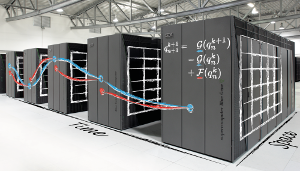
Cependant, peu encore ont essayé d’appliquer une méthode de parallélisation en temps à l’étude d’un écoulement turbulent résolu par simulation directe. Or, les codes CFD actuels, massivement parallèles en espace, atteindront leurs limites de scalabilité avec les super-calculateurs de demain, et profiteraient donc particulièrement d’une nouvelle dimension de parallélisation.
Le but de ce séminaire est donc de présenter de manière synthétique l’histoire et l’état de l’art de la parallélisation en temps, puis de se focaliser sur l’algorithme Parareal, afin d’en présenter plus en détail le fonctionnement et de l’illustrer par plusieurs exemples. Enfin, un accent particulier sera porté sur l’application d’un tel algorithme à un problème de mécanique des fluides turbulents (Turbulence Isotrope), afin de mettre en évidences les différentes problématiques qu’il faudra maîtriser pour réaliser une parallélisation en temps réellement efficace.
Modélisation de turbomachines par termes sources pour la simulation des interactions avion-moteur
- Jeudi 18 février 2016 - 11h00 - salle 38.137 - par William Thollet
Avec l’augmentation du taux de dilution des turboréacteurs modernes, le diamètre des moteurs d’avion civil devient de plus en plus important, ce qui accroît le poids et la trainée de l’installation motrice. Une solution envisagée pour contrebalancer cet effet est de diminuer la longueur de l’entrée d’air, dont la fonction est d’alimenter la soufflante avec un écoulement sain. Cependant, cette solution provoque l’émergence de nouvelles interactions aérodynamiques entre ces deux composants, qui doivent être prises en compte lors de leur design respectif. Bien qu’il soit possible de prédire fidèlement ces interactions à l’aide de simulations instationnaires de la soufflante dans l’entrée d’air, cette approche est aujourd’hui trop couteuse pour être utilisée dans des boucles de design quotidiennes. Ce travail de thèse se concentre par conséquent sur un type particulier de modélisation de turbomachines, dont le but est de prendre en compte la soufflante avec précision et à moindre coût. Dans cette optique, des termes sources qui reproduisent son effet sur l’écoulement sont injectés dans les équations RANS, la problématique étant alors de déterminer comment construire ces termes sources pour représenter aussi fidèlement que possible le comportement de la soufflante.
Étude et contrôle du décrochage d’une aile rigide multi-éléments
- Vendredi 29 janvier 2016 - 11h00 - salle 38.137 - par Alessandro Fiumara
L’aile rigide « wingsail » est le moyen de propulsion des catamarans d’ « America Cup ». Ce nouveau gréement a permis d’améliorer les performances des bateaux mais les équipages ont montré une certaine difficulté à régler l’aile dans toutes les conditions de navigation. En effet l’enveloppe globale des performances d’une aile rigide n’est pas encore parfaitement comprise et les phénomènes aérodynamiques complètement caractérisés. Une campagne expérimentale en soufflerie a été donc effectuée sur une maquette d’aile bi-élément à l’échelle pour en caractériser l’écoulement. Des simulations numériques RANS ont aussi été mises en place sur l’aile dans les conditions de soufflerie. Le domaine de soufflerie a dû être modélisé pour reproduire les effets d’interaction avec l’aile qui en modifiait les caractéristiques de l’écoulement. Les résultats numériques ont montré une bonne correspondance avec les données expérimentales en termes de prédiction des coefficients et en termes de reproduction de la structure de l’écoulement. Des différences ont été notées sur la modélisation du jet de fente à cause des effets de déformation de la maquette pendant les essais en soufflerie. En effet, ce jet est très sensible à la géométrie de la fente mais il a aussi une influence très importante sur les possibilités d’high-lift de l’aile et sur son comportement au décrochage.