 Networks and telecommunications
(5)
Networks and telecommunications
(5)
 Information Technologies
(12)
Information Technologies
(12)
 Personal Computer
(13)
Personal Computer
(13)
 EMAIL
(7)
EMAIL
(7)
 Communication
(4)
Communication
(4)
 Documentation
(1)
Documentation
(1)


 Collaborative tools
(12)
Collaborative tools
(12)
 Remote conferencing
(5)
Remote conferencing
(5)
 IT Organization
(25)
IT Organization
(25)
 IT Security
(4)
IT Security
(4)
 Scientific computing
(1)
Scientific computing
(1)
 Innov’Space
 High Performance Computing
(16)
High Performance Computing
(16)
 Digital Learning
(10)
Digital Learning
(10)
 Education licences softwares
(5)
Education licences softwares
(5)
 Digital rooms
(6)
Digital rooms
(6)
 Administration management
(9)
Administration management
(9)
 Human Resources
(5)
Human Resources
(5)
 Administrative Schooling
(2)
Administrative Schooling
(2)

 DAEP 2021 seminars

Published monday 14 December 2020
Modified 3 December 2021.
Room 38.137 and Hyflex
Room 38.137 and Hyflex
Room 38.137 and Hyflex
Room 38.137 and Hyflex
Room 38.137 and Hyflex
Room 38.137 and Hyflex
Room 38.137 and Hyflex
Room 38.137 and Hyflex
room 38.137
salle 38.051
salle 38.137
DAEP seminars in 2021
Low-fidelity numerical method for the aeroelasticity of flexible blades
- Friday, May 21, 2021 - 11:00 a.m. - room 38.137 and Hyflex - by Vincent Proulx -Cabana
Aeroelastic simulation requires aerodynamic modeling of forces and structural response. Potential methods, commonly used in fast aerodynamic prediction software, are called low-fidelity methods as they are based on the assumptions of potential flow, i.e. incompressible and non-viscous. The Vortex Lattice Method (VLM) is one of the simplest and fastest potential methods, since it only requires the discretization of the camber line of the airfoils. The addition of a fast nonlinear coupling allows to locally overcome some of the limitations of potential flows by introducing nonlinear effects such as viscosity or transonic effects contained in a 2D profile database. For a 3D aerodynamic simulation of a rotating wing, an unsteady free wake method is preferred if no assumptions on the wake shape are to be used. The Unsteady Vortex Lattice Method (UVLM) can be used, but the results may be affected by substantial deformation of the wake panels for long simulations or in the vicinity of obstacles. To avoid this problem, the vortex panels can be converted into particles (VPM) that are free to move independently of their neighbors. Unfortunately, VPM introduces two additional difficulties, i.e. numerical instabilities and the drastic increase in the computational cost of the wake evolution which is an O(n^2) order operation, where n is the number of particles. The numerical complexity can be reduced to order O(n) by implementing the Fast Multipole Method (FMM) which is very well suited for particle simulations. The stability of the VPM is achieved by introducing viscous dissipation in the wake. In this work, this dissipation is performed with the Particle Strength Exchange (PSE) which is an integral approximation of the diffusion operator in which an LES viscosity is added to the air viscosity to stabilize the simulations. This fast aerodynamic method achieves, at a fraction of the numerical complexity, results comparable to the higher fidelity experimental and numerical results from the 2nd Hover Prediction Workshop conducted on a 4-blade S76 rotor in hover. The results of this method are also compared to experimental results in ground effect. The aerodynamic forces predicted by this method are then coupled to a finite element modelling by beam elements representing the stiffness of the blades in order to model their deformation. The finite element representation is kept in the time domain rather than the frequency domain in order to preserve the simulation of non-linearities, to facilitate the coupling with the UVLM and in anticipation of a future control of aeroelastic instabilities. The coupling must be iterated, since the shape of the geometry affects the aerodynamic calculation, which in turn modifies the deformation calculation. The internal centrifugal force induced by the rotation is applied punctually to each node of the finite element structure. A relaxation factor is applied to the displacement update in the aeroelastic coupling to ensure convergence. For the moment, the simulations are limited to quasi-stationary cases, since the unsteady finite element model has not yet been implemented. The use of this quasi-stationary aeroelastic coupling should allow the determination of the deflection and rotation of a blade in a stationary loading case such as hover flight.
Experimental study of the Richtmyer-Meshkov instability-induced turbulent mixing
- Friday, May 7, 2021 - 11:00 a.m. - room 38.137 and Hyflex - by Marta Rasteiro Dos Santos
Tribulations of the inter-turbine channel
- Friday, April 30, 2021 - 11:00 a.m. - room 38.137 and Hyflex - by Alessio Firrito
Today (more so than in the 1970s), engine design aims to reduce fuel consumption, both to comply with aeronautical regulations and, above all, to increase the profitability of the aircraft by reducing the impact of fuel costs on the aircraft’s operating costs (around 37% today). One of the levers available is the improvement of the efficiency of the components that make up the engine, in particular the high and low pressure turbines.
The evolution of engines over the years has led to the development of high and low pressure turbines which have different needs: the integration of the two, by means of an inter-turbine channel, is more and more complicated. The aerodynamics of the inter-turbine channel is completely 3D; the flow leaving the high pressure turbine is very heterogeneous in pressure and temperature, and the high levels of turbulence make this part particularly sensitive to boundary conditions, which are often poorly controlled.
From an industrial point of view, the prediction of the performance of this component is crucial, but it remains complicated to calculate with the “best practice” of the industry. Several avenues of investigation are proposed, with a simplification of the geometry to isolate and study a particular phenomenon.
Study of the flow in the cavities at the top of a low pressure turbine wheel
- Friday, April 9, 2021 - 11:00 am - room 38.137 and Hyflex - by Maxime Perini
In a context of global warming, the aeronautics sector must reduce its CO2 emissions. For several years now, numerous regulations have been moving in this direction and have caused the industry to evolve. Engine manufacturers have been strongly impacted by this and must now face major challenges. In order to meet these objectives, the performance of each module making up the engine is pushed to the optimum with a view to increasing engine efficiency. Current technologies have made it possible to achieve very high levels of efficiency, making any improvement achievable at the cost of an increasingly important research and development effort. Thus, after having optimized the efficiency of turbomachines by significantly improving the flow around the blades, designers must now face the optimization of technological effects, such as the cavities at the top of the impeller. Indeed, the flow in the vicinity of this zone of interest is loss-making and must be studied in order to find ways to improve turbine efficiency.
High-order numerical methods for unstructured grids and sliding-mesh
- Friday, March 26, 2021 - 11:00 a.m. - room 38.137 and Hyflex - by Gonzalo Saez-Mischlich
The study of the high-order spatial discretization for conservation laws is crucial to improve the numerical accuracy of compressible turbulent flows simulations through Large-Eddy-Simulations (LES) and under-resolved Direct-Numerical-Simulations (DNS). This seminar will present the on-going effort to implement and validate different high-order Finite-Volume and Spectral-Element methods (Flux-Reconstruction and Spectral-Difference) for unstructured grids within our in-house LES solver IC3 and in a newly developed Spectral-Difference GPU-based solver written on top of the well-known PyFR solver. The comparison between CPU and GPU-based solvers will be then discussed using the performance-per-euro and performance-per-watt parameters. In addition, the influence of grid motion on the numerical accuracy of simulations, in the context of Arbitrary-Lagrangian-Eulerian methods, will be discussed. At last, a non-conformal sliding-mesh method, which allows to solve conservation laws in domains which present relative motions and is compatible with the aforementioned numerical methods, will be described and analyzed.
Passive aeroelastic control of aircraft wings via nonlinear oscillators
- Friday, March 12, 2021 - 11:00 a.m. - room 38.137 and Hyflex - by Claudia Fernandez-Escudero
Aeroelastic phenomena occur when a structure interacts with a surrounding flow and are one of the major factors limiting the flight envelope of aircraft. This fluid-structure interaction can lead to structural damage, either immediate or due to fatigue. Since the beginning of aviation history, aeroelasticity has been an important factor in aircraft design. Today, advances in the aviation industry are leading to the design of more efficient wings, usually with longer geometries and the use of lighter, more flexible materials. These new wings are more prone to aeroelastic behaviour than ever before, which means that aeroelastic control remains an important area of study. In addition, new drone designs are challenging traditional aeroelasticity.
The objective of this work is to present, analyze and test an innovative solution that controls the aeroelastic behavior of an aircraft wing for safer flight conditions and/or an extended flight envelope. The presented solution is based on secondary absorbers used to date on other applications, such as suspension bridges. The control system is passive, which means that no external energy input is required. The system is integrated into the wing by a flap that oscillates in the flow. The advantages of this flap are that the secondary oscillator is placed in the flow to benefit from aerodynamic damping and it adds low mass, which is always a priority in aeronautics. The control system can have a non-linear stiffness making it effective at broadband frequencies. This is an important feature because the wing frequencies will change with the wind speed.
In order to present and validate this innovative control device in the complex field of nonlinear aeroelasticity, a dual approach is followed using both experimental analysis and numerical simulations. Concerning the experimental approach, two test benches are created and tested in a wind tunnel: a two-dimensional wing and a three-dimensional wing.
The first experimental rig consists of a two-dimensional wing configuration with two degrees of freedom, with a flap that can be locked or unlocked as a third degree of freedom, acting as a secondary oscillator. This model provides a proof of concept of the control system and highlights the advantages of non-linear features over a linear version. It is observed that the two-dimensional wing exhibits classical flutter by coalescence of its two structural modes. When the control system is unlocked, the flutter speed increases, thus expanding the flight envelope. Moreover, the control system shows good vibration dissipation performance during the post-float regime, especially when equipped with a non-linear stiffness.
The second experimental rig consists of a three-dimensional elastic wing configuration, embedded at one end and free at the other. Again, similar to the first test rig, the wing has a flap that can be unlocked and equipped as a passive control system this time with a more localized and realistic effect. The objective of the configuration is to make a second proof of concept of the control system, but this time taking into account three-dimensional structural and aerodynamic effects. The non-linear characteristics, which were advantageous in the previous proof of concept, are retained for the control system. The three-dimensional wing exhibited “vortex induced vibrations” and the dissipation of the vibrations was observed by unlocking the control device. However, some of the parameters of the passive control flap are varied affecting its control capability, so the importance of proper design was emphasized.
The need to perform parametric optimization of the control device makes numerical simulations a major asset. Firstly, different numerical methods were compared in order to identify their ability to capture the complex non-linear aeroelastic behaviour of a two-dimensional wing. In addition, the computational time and cost were evaluated. For this purpose, four different methods are adapted to the selected test cases from the literature. The methods range from low-fidelity Theodorsen-based analytical codes to high-fidelity computer fluid dynamics codes coupled with a moving mesh with Euler and Unsteady Reynolds Averaged Navier-Stokes methods. A medium fidelity method, the unsteady vortex lattice method, is also selected for comparison. The methods all show good agreement for the selected test cases and the lower fidelity methods gain several orders of magnitude in computational speed over the higher fidelity methods. The development and comparison of these tools is a first step to complete the experimental proof of concept of the control system with numerical simulations.
Overall, the work presents a new innovative control solution and proves its effectiveness in the aeroelastic control of both two- and three-dimensional wings. The strengths and weaknesses of the control system are highlighted and the necessary tools for further development of the device are put in place.
Global stability of the compressible flow around a NACA0012 profile at low Reynolds numbers
- Friday, March 5, 2021 - 11:00 a.m. - room 38.137 and Hyflex - by Laura Victoria Rolandi(presentation)
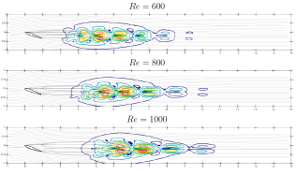
- Mode oscillant le plus amplifié à α=20°
The futuristic Hyperloop project, stratospheric flight and Martian exploration are characterized by the movement of objects in a fluid environment of low density or pressure. Under these conditions, the flow develops in a particular regime, that of compressible flows with low Reynolds numbers. In this context, we propose to analyze to what extent the effects of compressibility influence the dynamics and stability of the flow around a NACA0012 profile. The unsteady flow obtained by DNS is characterized for several values of Reynolds number Re and Mach number M, and different incidence angles α. For these same parameters, a steady flow is then obtained by filtering using the Selective Frequency Damping method of Akervik et al. (2006). This stationary flow is used as the base flow for the global stability analysis. For each value of incidence, the neutral curve is determined in the(M, Re) plane. For a given Reynolds number, the compressibility has a stabilizing or destabilizing effect that depends on the angle of incidence. However, the increase of the Mach number induces a decrease of the critical Reynolds number whatever the incidence.
Accelerating fluid solvers using artificial intelligence techniques
- Friday, January 29, 2021 - 11:00 a.m. - room 38.137 and Hyflex - by Ekhi Ajuria-Illarramendi(presentation)
Accurately simulating the incompressible Navier-Stokes equations still constitutes a computationally expensive problem, mainly due to the resolution of the Poisson equation. This linear equation ensures the mass conservation using a kinematic constrain on the velocity field: ∇∙V=0. The main objective of my PhD thesis consists in accelerating an incompressible fluid solver, by using Convolutional Neural Networks. The expensive iterative process that corrects the velocity field issued from the advection calculation is substituted by a Neural Network (been up to 5 times faster than a traditional solver on the Von Karman vortex street test case). A hybrid approach has been proposed as well, mixing the network with a traditional Jacobi solver in order to guarantee a certain accuracy level.