 Networks and telecommunications
(5)
Networks and telecommunications
(5)
 Information Technologies
(12)
Information Technologies
(12)
 Personal Computer
(13)
Personal Computer
(13)
 EMAIL
(7)
EMAIL
(7)
 Communication
(4)
Communication
(4)
 Documentation
(1)
Documentation
(1)


 Collaborative tools
(12)
Collaborative tools
(12)
 Remote conferencing
(5)
Remote conferencing
(5)
 IT Organization
(25)
IT Organization
(25)
 IT Security
(4)
IT Security
(4)
 Scientific computing
(1)
Scientific computing
(1)
 Innov’Space
 High Performance Computing
(16)
High Performance Computing
(16)
 Digital Learning
(10)
Digital Learning
(10)
 Education licences softwares
(5)
Education licences softwares
(5)
 Digital rooms
(6)
Digital rooms
(6)
 Administration management
(9)
Administration management
(9)
 Human Resources
(5)
Human Resources
(5)
 Administrative Schooling
(2)
Administrative Schooling
(2)

 DAEP Seminars 2015

Published wednesday 6 December 2017
Modified 6 September 2021.
Modal stability of rotating coaxial jets by Jessie Weller-Calvo followed by Aeroacoustic optimization of micro-UAV rotor by Cyril Nana
DAEP seminars in 2015
Modal stability of rotating coaxial jets
- Friday, December 11, 2015 - 11:00 a.m. - Room 38.137 - by Jessie Weller-Calvo
The study of the transitional dynamics of rotating jets is largely motivated by the understanding of the physical mechanisms at the origin of vortex breakdown. This intense phenomenon, which results in the sudden flaring of the core into a new coherent and stable structure, can be observed in many flows (tornadoes, apex vortices on delta wings, injectors in engines ...), as soon as the rotation intensity is high enough. This vortex burst results in a strong decrease of the axial velocity of the jet until a stop point appears on its axis, as if a solid obstacle had been introduced in the flow. Its origin is in the development, upstream of the stopping point, of a disturbance which is structured in the form of a helix whose azimuthal periodicity varies according to the parameters of the basic state (rotation intensity, Reynolds number...).
In this work we conduct a linear stability study of a simplified analytical model composed of a rotating jet and an outer annular jet. The strong ciculation drop within the central jet gives rise to a centrifugal instability which combines with axial shear instabilities. These instabilities can then contaminate the entire flow (absolute instabilities), or be carried by the flow (convective instabilities). After identifying the convective or absolute nature of the instabilities as a function of the outer jet velocity and the rotation intensity, we will look at the topology of the most unstable modes.
Aero-acoustic optimization of micro-UAV rotor
- Friday, December 11, 2015 - 10:00 am - room 38.137 - by Cyril Nana
The significant development of micro-UAVs for a wide range of missions (surveillance, police, military, television, cinema, archaeology, delivery, etc.) requires the use of silent rotors to ensure their discretion and reduce disturbance to the population as much as possible. The aeroacoustic optimization of micro-UAVs thus represents a major challenge. This involves finding a compromise between acoustic signature and aerodynamic performance. As the main source of noise is linked to the rotation of the rotor blades, the effort is focused on optimizing their shape. After a scan of the initial geometry, it enters an optimization process via the MAVLAB platform consisting of a coupled calculation of aerodynamic forces by the blade element method (BEMT) and aeroacoustic forces by the Ffowcs-Williams and Hawkings (FWH) analogy. An extensive study allowed to identify the most sensitive parameters and to modify the reference geometry accordingly, thus reducing the acoustic signature by 3dB without affecting the efficiency (at constant thrust).
Adaptation of phase-lagged boundary conditions to the large-eddy simulation of a turbomachinery stage
- Friday 13 November 2015 - 11:00 am - room 38.137 - by Gaëlle Mouret
A better understanding of turbulent unsteady flow is a necessary step towards a breakthrough in the design of modern compressors. With the increase in computing power, Large-Eddy Simulation (LES) emerges as a promising technique to improve both knowledge of complex physics and reliability of flow solver predictions. However these simulations are very expensive for industrial applications, especially when a 360° configuration should be considered. There are some paths to explore in order to reduce the computational cost of LES, with acceptable physical restrictions. In that regard, the use of the well-known phase-lagged boundary conditions allows a reduction of a 360° configuration to a single passage per row configuration, as proposed by Erdos and Alzner. The main difficulty with such conditions is the need to store the flow over one period at the phase-lagged interfaces. Erdos initially proposed to store the whole signal, but considering the meshes and time steps used in practical turbomachinery simulations, it represents a significant cost in memory. Actually, the most popular method to reduce the memory cost is to store only the coefficients of the Fourier Series Decomposition (FSD) of the temporal signal, as proposed by He. The FSD is truncated to a limited number of harmonics and the coefficients are updated at each time step with the Shape Correction method. This method assumes that the flow is perfectly periodic in time, which is a fair assumption in unsteady RANS for operating points dominated by periodic rotor/stator interactions (wakes and potential effects). Unfortunately, such periodic assumption is no longer true for LES. A new method for phase-lagged boundary conditions adapted to LES has been developped in which a Proper Orthogonal Decomposition replaces the FSD. This kind of decomposition does not make any assumption on the spectrum of the flow. The compression is done by removing the smallest singular values which are the ones that contain the least energy. This method has been validated with the URANS simulation of the single stage compressor CME2 and is then applied to the LES of this same compressor.
Numerical optimization of aircraft wing design: dream or reality?
- Friday, October 16, 2015 - 11:00 a.m. - Thesis Room - by Joaquim R. R. A. Martins
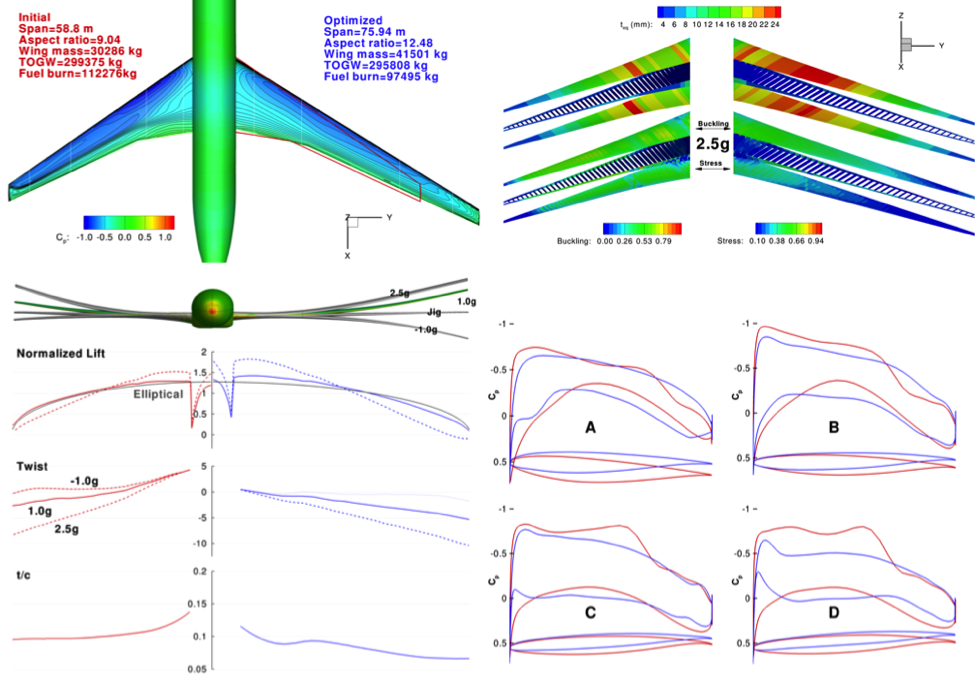
Wing shape is a crucial aircraft component that has a large impact performance. Wing design optimization has been an active area of research for several decades, but achieving practical designs has been a challenge. One of the main challenges is the wing flexibility, which requires the consideration of both aerodynamics and structures. To address this, we proposed the simultaneous optimization of the outer mold line of a wing and its structural sizing. The solution of such design optimization problems is made possible by a framework for high-fidelity aerostructural optimization that uses state-of-the-art numerical methods. This framework combines a three-dimensional CFD solver, a finite-element structural model of the wingbox, a geometry modeler, and a gradient-based optimizer. This framework computes the flying shape of a wing and is able to optimize aircraft configurations with respect to hundreds of aerodynamic shape and internal structural sizes. The theoretical developments include coupled-adjoint sensitivity analysis, and an automatic differentiation adjoint approach. The algorithms resulting from these developments are all implemented to take advantage of massively parallel computers. Applications to the optimization of aircraft configurations demonstrate the effectiveness of these approaches in designing aircraft wings for minimum fuel burn. The results show optimal tradeoffs with respect to wing span and sweep, which was previously not possible with high-fidelity models.
Insect-inspired Flapping-wing Micro Air Vehicle Aerodynamics Research
- Friday, September 25, 2015 - 11:00 a.m. - Room 38.137 - by Prof. Kevin Knowles
This seminar will discuss the rationale behind micro air vehicles and the benefits of taking inspiration from insect flight. It will describe some key recent findings and present the Cranfield-patented “Flapperatus”, a flapping-wing apparatus designed for experimental studies of insect aerodynamics.
Near-Wall Turbulence Modification By Tuned-Wall Impedance
- Wednesday, September 16, 2015 - 11:00 a.m. - thesis room - by Carlo Scalo
Numerical simulations by Scalo, Bodart and Lele, Phys. Fluids (2015) of compressible turbulent channel flow with linear acoustic impedance boundary conditions (IBCs) have revealed a new type of fluid dynamic instability triggered by the nonlinear interaction between wall-normal acoustic resonance and hydrodynamic events in the buffer layer. IBCs are akin to porous boundary conditions modeling surfaces with well-defined acoustic response properties, such as aeronautical acoustic liners. The impedance adopted is a mass-spring-damper-type oscillator with resonant angular frequency,wr, tuned to the characteristic time scale of the large energy-containing eddies. The tuning condition readswr = 2piMb, normalized with the speed of sound and channel half-width. The adopted numerical coupling strategy allows for a spatially and temporally consistent imposition of physically realizable IBCs in a fully explicit compressible Navier-Stokes solver. The IBCs are formulated in the time domain according to Fung and Ju, Int. J. Comput. Fluid Dyn. 18, 503-511 (2004).

The application of the tuned IBCs results in a drag increase up to 500%. Typical buffer-layer turbulent structures are completely suppressed by the application of tuned IBCs. At sufficiently high Mach numbers,Mb, and/or high porosities, the application of tuned IBCs generates strong hydro-acoustic instabilities confined in a resonance buffer layer. The layer is characterized by a streamwise-periodic array of spanwise-coherent Kelvin-Helmholtz rollers, completely replacing classic buffer-layer turbulent coherent structures. Such large-scale vortical structures remain confined near the wall and travel downstream with advection velocity cx = lxfr, where lx is the average distance between two adjacent rollers andfr =Mb is the (dimensionless) tuned resonant frequency. The advection velocity is therefore a function of the streamwise extent of the computational domain Lx, being lx necessarily an integer fraction of Lx. The hydrodynamic instability responsible for the generation of the Kelvin-Helmholtz rollers is triggered by the interaction between the background mean velocity gradient and high-amplitude wall-normal propagating waves at the frequencyfr. The latter result, in turn, from resonant excitation of the tuned IBCs and are evanescent in the outer layer. The alteration of the near-wall turbulent structure leads to a significant increase in the Reynolds shear stress near the wall. In particular, the asymptotic value of the Reynolds shear stress gradient near the wall is non-zero, resulting in a departure of the mean velocity profiles from the law of the wall, while all statistical quantities in the outer layer collapse for all porosities investigated if normalized by friction velocity. The mean velocity profiles in the outer region preserve a logarithmic behavior in all cases. This shows that the resonance buffer layer remains confined near the wall by tructurally unaltered outer-layer equilibrium turbulence.
Numerical simulation of the flow around the fenestron of a helicopter
- Wednesday, June 24, 2015 - 11:00 a.m. - room 38.137 - by Morgane Marino
Manipulation of turbulent shear-flows
- Monday 22 June 2015 - 10:45 - Amphi 4 - by Vladimir Parezanovic
Control of fluid flows is a subject rapidly growing in importance in recent years. With the advent of more sophisticated sensors and actuators, and the computing power to process large amounts of data in real time, the closed-loop control becomes far more interesting and feasible in realistic engineering applications than ever before. Passive control devices or active periodic forcing has been shown many times to be effective, but only near a certain design point with respect to flow conditions. In varying flow conditions or in the presence of external perturbations, these methods of control do not only lose their efficiency but can even provoke negative effects. Closed-loop control is by definition more robust to such difficulties. The current issues and opportunities in experimental control of turbulent shear-flows, are presented using two fundamental examples: the bluff cylinder wake and the planar mixing layer. Although the mixing layer is a fundamental component of cylinder wakes and cavity flows, these flows act as oscillators governed by an absolute instability. Oscillator flows are far less sensitive to stochastic perturbations and the incipient global mode can be well represented (for the purpose of control) by linear models or low-dimensional vortex models. In contrast, a freely developing mixing layer is a pure noise amplifier and, as such, poses even greater challenges to control design. For this class of turbulent flows, the evolution of dominant frequencies with respect to the location of the observer is a result of highly non-linear mechanisms which makes control using linear models extremely difficult.
In the first part of the presentation we will take a look at how a modification of the shear layer properties can affect the global mode of the bluff body wake (the Von Karman vortex street). The flow is controlled using a much smaller circular control cylinder, as a steady perturbation in the bulk of the primary cylinder wake. The presence of this small control cylinder can significantly change both the drag of the main bluff body as well as the frequency of the vortex street global mode. In the second part of the presentation we will address closed-loop control of a freely developing planar mixing layer. The control design used is of a feedback type, meaning that the sensors are placed downstream of the actuator system (pulsing jets) in a purely convective flow of the mixing layer. We will discuss the Genetic Programming as a model-free method for control design, in such flows where the model-based control methods are (at this moment) unsuccessful. The concluding arguments will discuss new directions for future research in the design of robust MIMO (Multiple-Input, Multiple-Output) controllers, as well as propose flow problems interesting as a target for closed-loop control experiments. These experimental studies are essential in understanding the basic flow phenomena and how to target them, if a concept like the “smart wing” is ever to be fully exploited in everyday engineering.
Dynamics of a shock wave/boundary layer interaction
- Thursday 18 June 2015 - 10:45 - salle des thèses - by Jean-Christophe Robinet
The interaction between a shock wave and a boundary layer (IOCCL) is a common phenomenon encountered on aircraft and aerospace vehicles. For certain aerodynamic conditions, the IOCCL system can be subject to self-sustaining low frequency dynamics. These unsteadinesses induce aerodynamic loads that are detrimental to aerodynamic performance. However, the physical origin of these low frequencies is poorly understood.
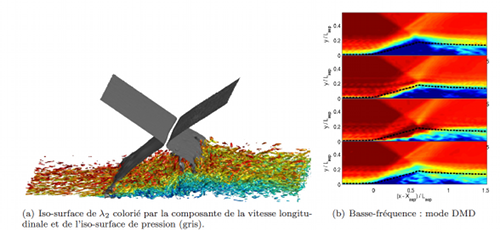 The objective of this seminar is to review the current knowledge in this field and to give some ideas for future developments. The unsteady low and medium frequency dynamics of an interaction between an oblique shock wave and a boundary layer on a flat plate is studied in different flow configurations (transitional and turbulent). Different numerical tools have been developed: large scale simulations, URANS methods, linear stability analyses and dynamic decomposition method (DMD). It has been shown that whether the IOCCL is laminar or turbulent, the physical mechanisms responsible for its dynamics are qualitatively the same. For a wide range of Reynolds and Mach numbers, the IOCCL is convectively unstable, i.e. its dynamics is of the selective noise amplifier type. The mean frequency dynamics is related to the dynamics of the shear layer as well as to the recirculation zone. These dynamics can be partly predicted by a linear analysis. The low frequency dynamics is of non-linear origin and originates from the non-linearities of the shear layer as well as from a pressure feedback loop.
Flow interactions around a rapidly-pitching wing
- Tuesday, June 9, 2015 - 3:00 p.m. - room 38.137 - by Sergey Shkarayev(Presentation)
This study was conducted to visually investigate flows related to fixed-wing vertical-takeoff-and-landing micro air vehicles, using the smoke-wire technique. In particular, the study examines transition between forward flight and near-hover. The experimental model consists of a rigid Zimmerman wing and a propulsion system with contra-rotating propellers arranged in a tractor configuration. The model was pitched about the wing’s aerodynamic center at approximately constant rates using a five-axis robotic arm. Constant-rate pitching angles spanned 20 to 70 degrees. No-pitching and four pitching-rates were used, along with three propulsive settings. Several observations were made during no-pitching tests. Turbulent wakes behind blades and laminar flow between them produce pulsations in the boundary layer. These pulsations alter the boundary layer from a laminar to turbulent state and back. An increase in lift and drag in the presence of a slipstream is a result of competing effects of the propulsive slipstream: 1) suppression of flow separation and increased velocity over the wing and 2) decrease of the effective angle of attack. Higher nose-up pitching-rates generally lead to greater trailing-edge vortex-shedding frequency. Nose-up pitching without a slipstream can lead to the development of a traditional dynamic-stall leading-edge vortex (LEV), delaying stall and increasing wing lift. During nose-up pitching a slipstream can drive periodically-shed leading-edge vortices into a larger vortical-structure that circulates over the upper-surface of a wing in a fashion similar to that of a traditional dynamic-stall LEV. At lower nose-up pitching-rates LEVs form at lower angles of attacks. As a slipstream strengthens a few things occur: separation wakes diminish, separation occurs at a higher angle of attacks, and downward flow-deflection increases. Similar effects are observed for nose-up pitching, while nose-down pitching produces the opposite effects.
Port-Hamiltonian Systems
- Friday, May 22, 2015 - 11:00 a.m. - Cazalbou room - by Denis Matignon(Presentation) and Flávio Ribeiro(Presentation)
The objective of this two-part presentation is to highlight the advantages of structured mathematical modeling of physical systems in the Hamiltonian interaction port framework for the engineer confronted with multi-physics systems: fluid-structure interaction is a key example, whose interest in aeronautics is obvious. One of the interests of these methods is to preserve the underlying geometrical structure of the system, whether it is linear or non-linear, whether the internal state of the system is of finite dimension (governed by ordinal differential equations, ODEs) or infinite dimension (governed by partial differential equations, PDEs) and finally, in the latter case, whether the coefficients of the model are uniform or spatially variable. Another interest is that there are specific numerical methods, called geometrical or symplectic, which allow to preserve, at the discrete level, the fundamental relations of the energy balances initially formulated at the continuous level. Finally, a major interest is that this formalism integrates the interaction between subsystems as a constitutive element of the modelling: clearly, it is the open dynamic systems interacting with the outside world that benefit from it, as opposed to closed systems without exchange with the external environment.
In a first part, we will implement this formalism on extremely simple examples: mass-spring system, pendulum, vibrating strings, Euler-Bernoulli beam, and fluid governed by Euler or Navier-Stokes equations. Particular attention will be paid to the possible descriptions of fluids, at least for the well known elementary models. In a second part, we will present the coupling of these systems. First, we will show, from an example of mass-spring systems, that the interconnection of several Hamiltonian port systems is also a Hamiltonian port system. Then, we will deal with a more interesting example: the coupling of fluid dynamics and structures. Each element is described using this formalism, and the interconnection of the system guarantees energy conservation. Finally, a geometric discretization scheme is used, leading to an approximate finite dimensional system that retains some properties of the original system. The resulting model is used for simulation and is compared with experimental results.
Partial numerical results and further information can be obtained from this website.
Perspectives for future civilian propulsion: turbomachine system modelling within the context of european R&D initiatives
- Tuesday, April 28, 2015 - 11:00 a.m. - Cazalbou room - by Aleksandar Joksimovic(Presentation)
Compact spectral methods: central parts of tomorrow’s CFD?
- Friday, March 27, 2015 - 11:00 a.m. - Cazalbou room - by Raphaël Lamouroux(Presentation)
Study of a liquid film subjected to Faraday instability: theory, experiments and numerical simulations
Friday, February 27, 2015 - 11:00 a.m. - Cazalbou Room - by Henri Garih(Presentation)
This seminar deals with the study of the dynamics of a thin liquid film subjected to a normal excitation at its interface. This situation gives rise to so-called Faraday instabilities which, under certain conditions, lead to the formation of drops. In the context of fuel injection systems used in aeronautical propulsion, there are situations where the gas flow is not fast enough to effectively peel the fuel film. In this case, a forcing of Faraday instabilities can be envisaged to produce droplets with characteristics in size and flow favouring an efficient combustion.
We are interested in three configurations: first, the classical Faraday configuration: a liquid contained in a vibrating container, thus without liquid flow and without aerodynamic shear. Then, we are interested in a thin film flowing on an inclined plane but still in the absence of aerodynamic shear and finally, a thin film flowing on an inclined plane in the presence of aerodynamic shear. These three configurations were studied using three tools: linear stability, direct numerical simulation with interface capture and experimental approach. For each configuration, the results given by the different tools have been conclusively compared.
Aerodynamic study of a new convertible drone concept
- Friday, January 30, 2015 - 11:00 a.m. - Cazalbou Room - by Aurélien Cabarbaye
Presentation of the aerodynamic aspects of a new concept of convertible UAV whose rotor, allowing the sustentation in hovering flight, is transformed into duck plane in horizontal flight. The goal is to combine the performance of an airplane with the vertical takeoff and landing capability of a helicopter, while avoiding the drawbacks observed on existing convertibles. After a presentation of the concept and its expected performances, a discussion between the different speakers should allow to identify the difficulties and aspects to be deepened to demonstrate the relevance of such a concept