 Networks and telecommunications
(5)
Networks and telecommunications
(5)
 Information Technologies
(12)
Information Technologies
(12)
 Personal Computer
(13)
Personal Computer
(13)
 EMAIL
(7)
EMAIL
(7)
 Communication
(4)
Communication
(4)
 Documentation
(1)
Documentation
(1)


 Collaborative tools
(12)
Collaborative tools
(12)
 Remote conferencing
(5)
Remote conferencing
(5)
 IT Organization
(25)
IT Organization
(25)
 IT Security
(4)
IT Security
(4)
 Scientific computing
(1)
Scientific computing
(1)
 Innov’Space
 High Performance Computing
(16)
High Performance Computing
(16)
 Digital Learning
(10)
Digital Learning
(10)
 Education licences softwares
(5)
Education licences softwares
(5)
 Digital rooms
(6)
Digital rooms
(6)
 Administration management
(10)
Administration management
(10)
 Human Resources
(5)
Human Resources
(5)
 Administrative Schooling
(2)
Administrative Schooling
(2)

 DAEP 2012 seminars

Published wednesday 6 December 2017
Modified 6 September 2021.
DAEP seminars in 2012
Unsteady power supply for a radial turbine
Friday 14 December 2012 10:45 DAEP Jolimont by Nicolas Binder(Presentation)
If the recovery by a turbine stage under stationary operating conditions is now well mastered, the state of knowledge is less when the supply forces a transient or pulsed regime. However, this configuration is currently being considered, following technological developments in combustion chambers.
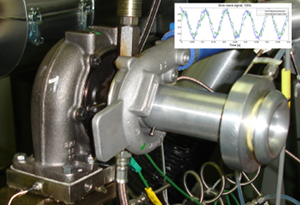 Both in aeronautics and in power generation, innovative concepts of detonation engine are studied. It is around automotive supercharging that most of the work available in the literature has been carried out. The radial turbine stage of the turbocharger is subjected to pulsed flow from the cylinders on the one hand, and to violent transient phases imposed by the driver on the other. These two types of instationnarity induce a rich spectrum of time scales in the stage feeding conditions, which it is not always obvious to decouple. This presentation summarizes the results obtained, mainly in the experimental analysis of a transient phase. After a general context of the need for unsteadiness in turbomachinery, the implementation of a transient behavior model allows to sort out the parameters influencing the reactivity performance of the turbine stage. Beyond the obvious influence of the moment of inertia, the aerothermodynamic performance of the stage is considered. The observed behaviour shows that it is necessary to detail upstream the development of a supply disturbance through the stage, in order to criticize the generally accepted quasi-stationary approach. The first results obtained during this mixed study (perimental and numerical) are presented. The conclusion is finally an opportunity to discuss the relevance of the usual performance indicators, since they are stationary.
On the robustness of scaling laws in 2D turbulence
Friday, November 30, 2012 10:45 am DAEP Rangueil by Jérôme Fontane(Presentation)
A new numerical technique for the simulation of forced two-dimensional turbulence is used to examine
the validity of Kraichnan-Batchelor scaling laws at higher Reynolds number than previously accessible with
classical pseudo-spectral methods, making use of large simulation ensembles to allow a detailed consideration
of the inverse cascade in a quasi-steady state. Our results support the recent finding of Scott, namely
that when a direct enstrophy cascading range is well-represented numerically, a steeper energy spectrum
proportional to k-2 is obtained in place of the classical k-5/3 prediction. It is further shown that this steep
spectrum is associated with a faster growth of energy at large scales, scaling like t-1 rather than Kraichnan’s
prediction of t-3/2 . The deviation from Kraichnan’s theory is related to the emergence of a population
of vortices that dominate the distribution of energy across scales, and whose number density and vorticity
distribution with respect to vortex area are related to the shape of the enstrophy spectrum. An analytical
model is proposed which closely matches the numerical spectra between the large scales and the forcing scale.
Transition to the chaos of an axisymmetric warhead wake
Friday, October 26, 2012 13:45 DAEP Jolimont by Yannick Bury(Presentation)
Numerical simulation of aeronautical combustion chambers
Wednesday 7 March 2012 5pm Amphi 2 Rangueil by Nicolas Bertier(Presentation)
Harmonic balancing method for time periodic problems
Friday 27 January 2012 10:45 DAEP Jolimont by Guillaume Dufour(Presentation)