Plan Vigipirate rehaussé au niveau urgence attentat. Restez vigilants et informés. En savoir plus

FREQUENTLY ASKED QUESTIONS - PSC PROVOYANCE - CIVILIAN PERSONNEL

Provident insurance covers you against the consequences of events that interrupt or suspend your professional activity, such as illness, accident, disability or death.

These risks have a low probability of occurring, but can have very serious consequences for an agent’s income and his or her family’s standard of living.

The interministerial agreement of October 20, 2023 relating to the improvement of provident cover (incapacity for work, invalidity, death) in the French civil service has defined a framework for so-called provident risks resulting from incapacity, invalidity and death with :

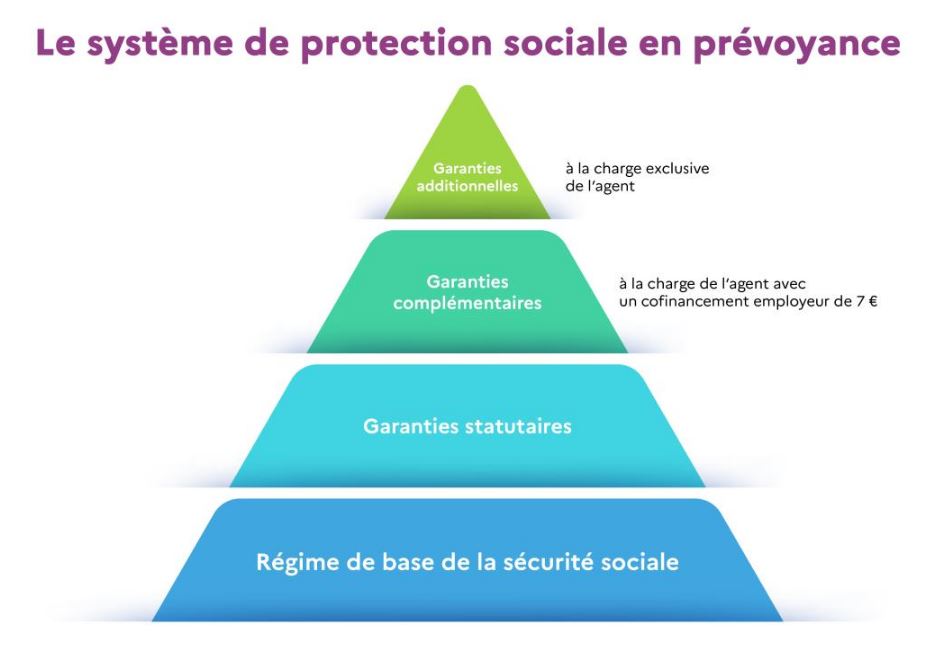
  • statutory guarantees, which are the responsibility of the administration,
  • supplementary and additional cover under a departmental group contract with optional membership.

Given the optional nature of group contract membership, the above-mentioned interministerial agreement has not been translated into a ministerial agreement for the Ministry of the Armed Forces.

This is a supplementary social security plan that the French government has decided to set up for its employees.

The reform of the PSC provident scheme combines guarantees provided by the employer (statutory guarantees) and guarantees provided by a complementary organization as part of the group contract.

The principles of the reform were defined in the interministerial agreement of October 20, 2023 on improving provident cover in the French civil service. For civil servants in the French State civil service, these principles are set out and specified in Decree no. 2024-678 of July 4, 2024 on supplementary social protection for civil servants in the French State civil service.

The plan includes guarantees covering the risks of death, incapacity and disability, on a complementary and additional basis. It sets out the terms of the employer’s financial contribution and the solidarity arrangements between beneficiaries.

No, the two systems are totally separate, and are covered by 2 different contracts.

Membership of the PSC provident scheme is not compulsory.

All civil servants, government workers, public-sector contract employees and private-sector contract employees not covered by a compulsory group contract as provided for in Article L911-1 of the French Social Security Code, employed and remunerated by the Ministry of the Armed Forces and its supervising public administrative establishments, are eligible to join the Ministry’s group contract.

Membership is not subject to any age or health conditions, provided it takes place within six months of the effective date of the group contract or the date of recruitment. Beyond that date, a health questionnaire may be required by the complementary health insurance company.

Retired employees cannot join the group contract as they no longer have any remuneration to maintain.

On the other hand, an employee who has subscribed to the group contract as an active member is entitled to the benefits provided under this contract if he or she is retired on grounds of disability.

Employees who have subscribed to the group contract and are in an unpaid statutory position are subject to contract suspension. For the period in question, they do not pay any contributions and therefore do not benefit from the cover provided during the period.

The contract is reactivated for the agent as soon as he/she returns to a paid statutory position, regardless of age or state of health.

For civil servants on secondment to another administration outside the Ministry, the contract is also suspended. The employee can then benefit from the contract negotiated by the new administration.

Affiliation is an individual process, initiated by the employee
directly with the complementary organization awarded the contract.

The employee must provide the complementary health insurance organization with the last pay slip available at the time of enrolment. The organization will request a new pay slip at least once a year, at the time of the call for contributions.

Once enrolment has been completed, the complementary organization will inform the Ministry of enrolment, so that employer co-financing can be set up. This co-financing will appear on the pay slip.

Referencing ends on January 1, 2026, but current referenced contracts are not automatically terminated. It should be noted, however, that the benefits provided by referenced contracts have not changed since 2018. In particular, these contracts do not cover the 90% cap on ordinary sick leave.

Generally speaking, if I have a provident contract, I can :

  • keep it, but I won’t benefit from state aid
  • cancel it under the insurer’s terms and conditions (usually 2 months before the expiry date).

It is possible to be covered by several provident policies at the same time. However, the benefits are deducted from each other. For example, if insurer A and insurer B both guarantee me 100% salary continuation for two years, and I am placed on long-term sick leave, only insurer A will pay me additional income.

Yes, membership of complementary benefits is co-financed to the tune of €7 per month.

On the other hand, any additional cover the agent may take out is entirely at his or her own expense.

The law stipulates that a change of insurer has no effect on the continued payment of benefits in payment. This means that the current insurer will continue to pay benefits, even after the contract has been terminated. These benefits are known as “deferred” benefits.

During the first six months of the group contract, my membership cannot be refused by the new insurer, and no additional premium is applied. However, medical conditions existing prior to enrolment are not covered by the new insurer.

This means I can join the group contract, but it will be suspended (no contributions or benefits will be paid) until I’m back in paid employment. However, enrolling under these conditions has the advantage of avoiding the medical questionnaire when you return to work.

After the first six months of the group contract, if I decide to subscribe to the new contract, the new insurer may refuse my application, or accept my application with an exclusion of cover or a higher premium, on the basis of the health questionnaire I will have to complete.

No medical questionnaire is required for enrolment in the group insurance plan for the first six months following :

  • the effective date of the group contract ;
  • the date of recruitment.

After this period, enrolment is subject to a medical questionnaire and, consequently, to medical selection.

For employees on sick leave at the date of application, membership is subject to the submission of a medical questionnaire, which gives rise to coverage, where applicable, with pathology exclusions.

The contract takes effect without a waiting period.

Yes, as membership is optional, it can be terminated under the conditions proposed by the complementary health insurance organization.

No, membership of the provident scheme is purely optional. If you decide to join this contract, you can join only the complementary benefits without joining the additional benefits.
On the other hand, it is not possible to sign up for the additional benefits only, without signing up for the supplementary benefits.

Yes, you can contact your complementary health insurance provider to cancel your membership on the contract expiry date.
either to increase or reduce your cover, or to cancel your membership.
your membership.

Incapacity is the temporary physical or mental inability to carry out a professional activity. This is the situation of an agent who is prescribed a work stoppage to allow time for treatment and recovery.

Disability is a medically recognized irreversible physical or mental condition. The term
disability when the ability to work is permanently reduced by at least two-thirds as a result of illness or accident.

In the civil service, disability may give rise to adaptation of the workstation, reclassification, availability for health reasons, striking off and retirement (for civil servants) or termination of the employment contract (for contractual employees).

The death benefit under the PSC prévoyance contract is paid regardless of the cause of death, whether on or off duty.

The lump-sum death benefit paid to beneficiaries in this way may be combined with that provided for under Decree no. 2024-555 of June 17, 2024 relating to death cover for civil servants, military personnel and government workers.

Death benefits pay the family of a deceased employee a lump sum or annuity to compensate, at least temporarily, for the sudden loss of financial resources due to the death of a member of the household.

The death benefit under the group contract is paid to the beneficiary designated by the employee during his or her lifetime.

The optional group contract contains so-called “additional” benefits. These
supplement the statutory cover provided by the employer.

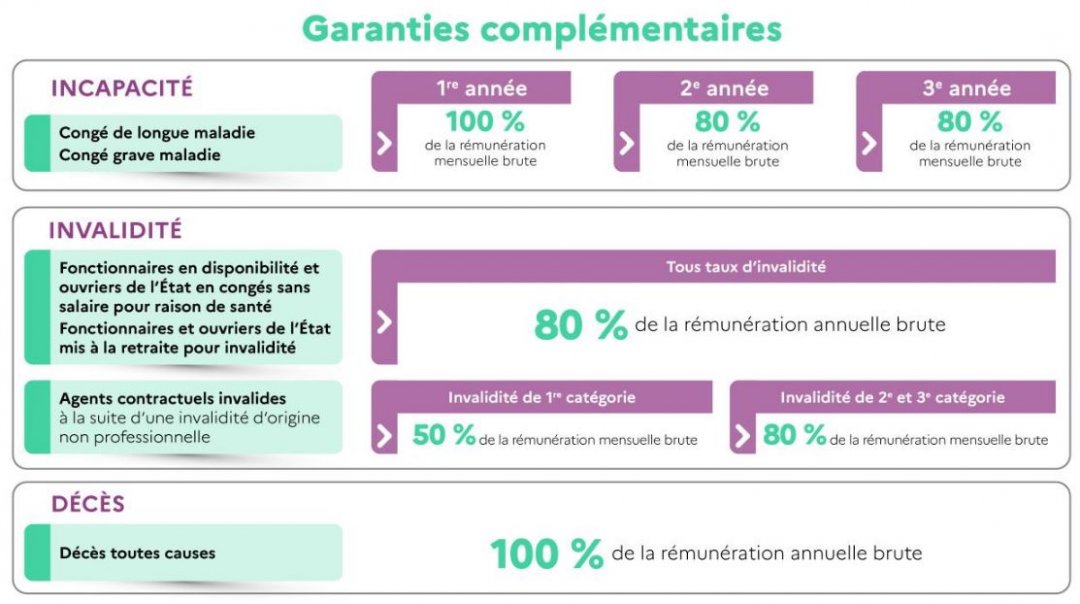
Supplementary guarantees cover the following risks:

* For the risk of incapacity: long-term sick leave for civil servants and state workers, and
as well as serious illness leave for contract employees.

This risk can be likened to “temporary total disability” (ITT).

Benefits paid in respect of the risk of additional disability are calculated as a percentage of the employee’s gross remuneration, after deduction of amounts already paid by the employer.

Benefits are capped so that an employee on sick leave cannot receive more income than if he or she had continued to work.

* In the event of disability: periods of unpaid leave for health reasons for civil servants
for civil servants, unpaid leave for health reasons for government workers, periods of disability
the period of disability compensated by social security schemes for contractual employees, as well as the period
the period between the liquidation of the retirement pension and the age of 62.

This risk can be likened to the risk of “permanent disability” (IP), partial (IPP) for 1st category disabilities, and total (IPT) for 2nd and 3rd category disabilities.

Supplementary disability benefits are calculated as a percentage of the employee’s gross salary, after deduction of amounts already paid by the employer, social security and pension schemes. Benefits are paid up to the age of 62.

Benefits are capped so that a disabled employee cannot receive more income than if he or she had continued to work.

* Death: death from any cause. This benefit is a lump-sum death benefit. The lump-sum
may also be paid out during the beneficiary’s lifetime in the event of total and irreversible loss of autonomy (PTIA) or permanent and absolute disability (IPA).
of autonomy (PTIA) or permanent and absolute disability (IPA).

The lump-sum death benefit provided by the additional benefits is equal to one year’s gross salary, including all bonuses and allowances.

The amount of the supplementary death benefit is calculated by the contractor on the basis of remuneration elements known at the time of death, independently of the amount of the statutory death benefit calculated by the administration.

This applies to both in-service and out-of-service deaths, pursuant to article 3° of decree no. 2024-678.

Details of additional benefits are shown in the table below:

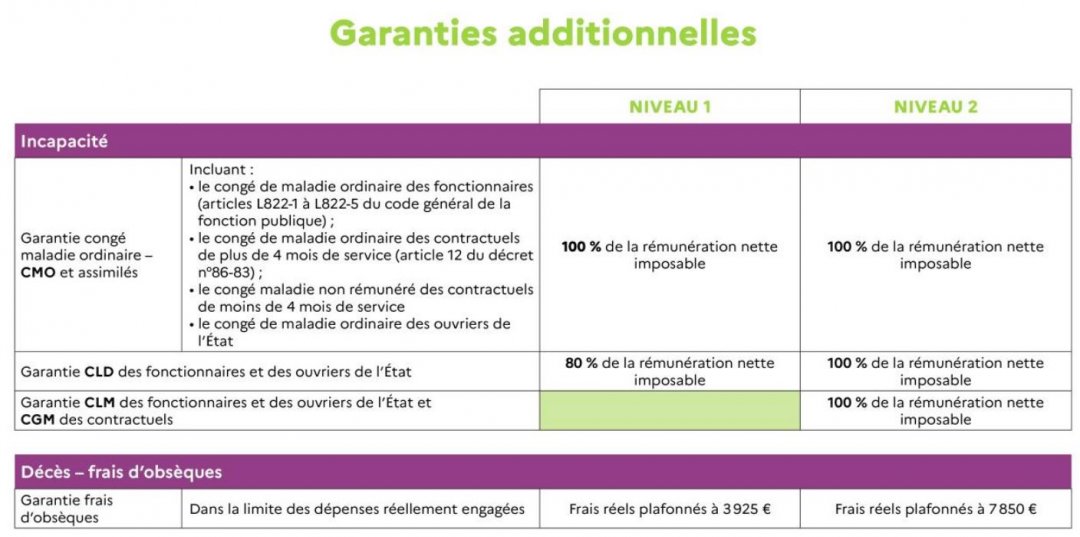
In order to offer cover tailored to policyholders’ needs, additional cover may be purchased
can be purchased.

These guarantees can only be taken out in addition to the complementary guarantee. There are two levels of additional cover.

The content of the guarantees and the level of benefits are as follows:

The PSC group provident contract will be implemented from January 1, 2026.