 Networks and telecommunications
(5)
Networks and telecommunications
(5)
 Information Technologies
(12)
Information Technologies
(12)
 Personal Computer
(13)
Personal Computer
(13)
 EMAIL
(7)
EMAIL
(7)
 Communication
(4)
Communication
(4)
 Documentation
(1)
Documentation
(1)


 Collaborative tools
(12)
Collaborative tools
(12)
 Remote conferencing
(5)
Remote conferencing
(5)
 IT Organization
(25)
IT Organization
(25)
 IT Security
(4)
IT Security
(4)
 Scientific computing
(1)
Scientific computing
(1)
 Innov’Space
 High Performance Computing
(16)
High Performance Computing
(16)
 Digital Learning
(10)
Digital Learning
(10)
 Education licences softwares
(5)
Education licences softwares
(5)
 Digital rooms
(6)
Digital rooms
(6)
 Administration management
(9)
Administration management
(9)
 Human Resources
(5)
Human Resources
(5)
 Administrative Schooling
(2)
Administrative Schooling
(2)

 THE SHIFT PROJECT AND THE SUPAERO DECARBOS COLLECTIVE PUBLISH THEIR NEW REPORT ON THE DECARBONISATION OF THE AVIATION SECTOR
Published tuesday 9 March 2021
Modified 15 June 2022.
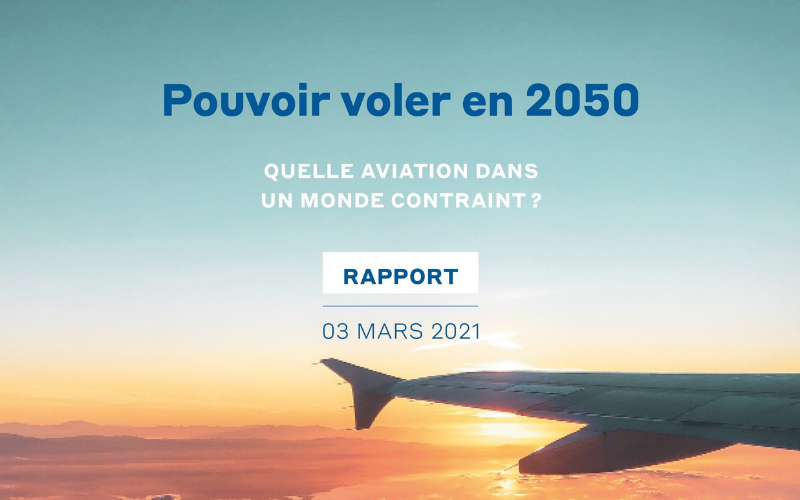
The Shift Project* and the Supaero Décarbos** collective publish their new report on the decarbonisation of the aviation sector: " Being able to fly in 2050: what aviation in a constrained world?"
Based on a scenario-based analysis of aviation emissions trajectories between now and 2050, the study attempts to shed light on the following questions: How can we act today to continue flying tomorrow in a constrained world? How can we steer the aviation sector towards trajectories that are compatible with climate issues and less dependent on fossil fuel supplies?
Olivier Lesbre, Director of ISAE-SUPAERO, welcomes the growing mobilization of engineers and the in-depth debate on the ecological transition of air transport. He shares his analysis of the situation and confirms the total commitment of the Institute’s activities to progress and innovation:
"The impact of air transport on global warming has been highlighted in the media for some years, often relying more on simple ideas or moral convictions than on scientific analysis. In recent months, with the aviation crisis triggered by Covid, the debate on the ecological transition of air transport has intensified and deepened, and has begun to take a more pragmatic turn, thanks to the growing mobilization of engineers on the subject. As a leading aeronautical engineering school, ISAE-SUPAERO is delighted with this development.
The essay “Being able to fly in 2050” is an illustration of this. It was written at the initiative of the SUPAERO-DECARBO collective, which for the past two years has brought together alumni and students of the Institute who are working to reduce the impact of the aeronautical sector on the climate. It is based on available scientific knowledge to make proposals on the future of the aviation sector that are compatible with the Paris climate agreements.
As the essay makes clear, there are many uncertainties in the forecasts of the evolution of emissions, which leads the authors to make assumptions and to identify choices that will be important for the future. Two of them in particular deserve discussion:
- The first is the share of the “human carbon budget” that can be devoted to aviation (or in other words, long-distance travel) between 2020 and 2050. This essay chooses to take it equal to the share of aviation in global emissions in 2019, while recognizing that this is an arbitrary choice. It is in fact a dimensional choice on the conclusions of this work, and it is a political choice. Most economists consider that it is not the best choice for reducing emissions globally, insofar as to be effective, one must first attack the sectors where it is easiest, such as electricity production, which mechanically leads to an increase in the relative share of sectors where it is more difficult, such as aviation.
- The second concerns the pace of technological progress. The natural tendency is to extrapolate it from the past. However, the speed with which the first vaccines against Covid were developed has just demonstrated vividly that this pace accelerates greatly when the international community of competent scientists and engineers focuses on an urgent problem. The Institute is confident that the same phenomenon is occurring for the decarbonization of our societies in general and air transport in particular. For its part, it is resolutely committed to this goal, by training engineers capable of leading the ecological transition of the sector in all its complexity, by putting the subject at the heart of its research activities and by contributing to the public debate.
In conclusion, the Institute welcomes this contribution by some of its students and alumni to a rational and structured public debate. The point of view expressed is well argued, but, like any prospective work, is based on hypotheses, some of which are questionable and still need to be discussed in depth. There is no doubt that this work will contribute to the quality of the debate on the future of air transport!
PS: the Institute has just put online a tool open to all that allows anyone to simulate the impact on global warming of the various assumptions that can be made about the evolution of aviation. This tool should naturally be of interest to readers of this report, and is available at cast.isae-supaero.fr
Olivier Lesbre,
General Management of ISAE-SUPAERO".
*The Shift Project is a think tank that works towards a carbon-free economy
**Former students of ISAE-SUPAERO who wish to contribute to the reflection on aeronautics, aviation and the role of the school and students in the context of climate change.